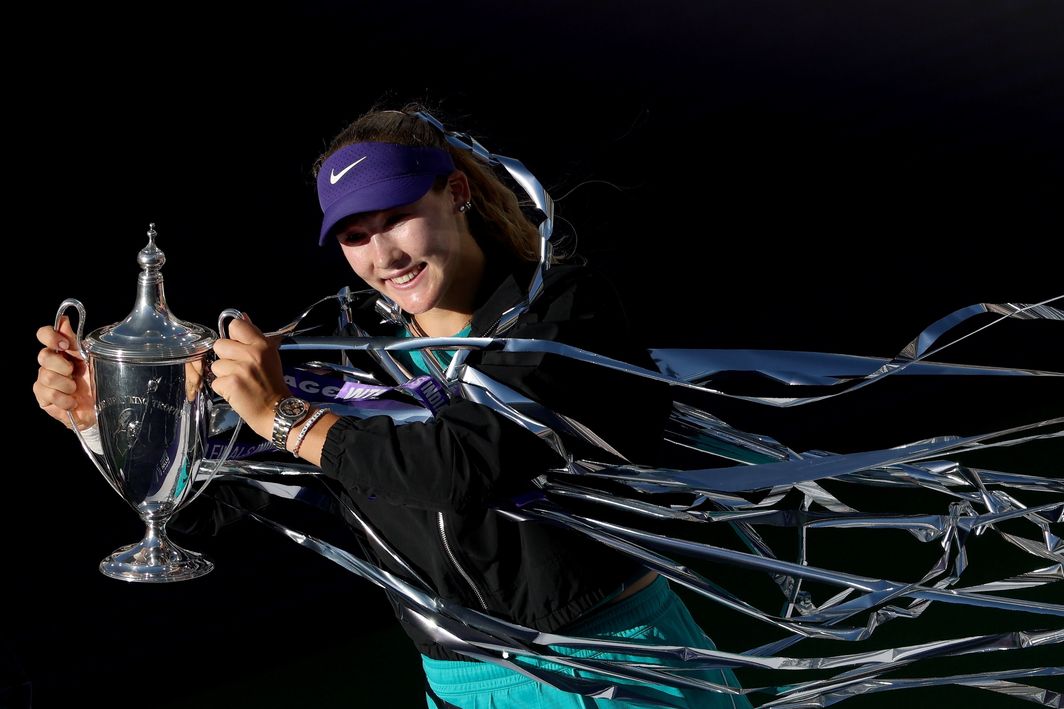
Andreeva's Perfect WTA Finals Week: What the Numbers Show
Mirra Andreeva won all 10 sets at the 2026 WTA Finals, conceded 26 games and rose to No. 2. Here is what the set and game data reveals about her title run.
Mirra Andreeva went 5-0 at the FAGE WTA Finals in Indian Wells, dropped no sets and finished the week with a 7-5, 6-3 win over Elina Svitolina. It is a clean recap on paper. The game-level numbers add more detail.
Andreeva's Perfect Week by the Numbers
Andreeva won 61 games and lost 26 across her five matches. That is 70.1 percent of games won, and it places her second on the tournament's all-time game-percentage list for a perfect-set run since round-robin play began in 2003.
- Set record: 10-0 (100%)
- Game record: 61-26 (70.1%)
- Games conceded: 26, second-fewest since 2003
- Age: 19, youngest champion since Maria Sharapova in 2004
The only lower total came from Iga Swiatek, who conceded 20 games in 2023. Swiatek's 62-20 record that year remains the benchmark.
Game Differential and Where the Week Was Won
Set scores hide how much the week was tested. Andreeva's path had three moments that stand out in the data.
First, Svitolina pushed the final. She was the first player all week to take more than four games off Andreeva in a set, and she forced the opener to 5-5 before Andreeva won the next two games.
Second, the round-robin win over Aryna Sabalenka was a comeback. Andreeva fell behind 4-1 and then won 11 straight games to take the match. In a short, round-robin format, a streak of that length can decide a group.
Third, Diana Shnaider was dispatched in 55 minutes. Quick wins in a week of five matches help a player conserve energy for the semifinal and final.
In the semifinal, Pegula led 3-1 in the second set. Andreeva still closed in straight sets.
Where the Run Ranks Among WTA Finals Champions
WTA ranked the title runs by sets won, with games won as the tiebreaker. Andreeva sits second, behind Swiatek's 2023 run and ahead of Serena Williams' 2012 title, when Williams went 61-32 (65.6%) in games.
Andreeva is also the third player in tournament history to win the title on debut without dropping a set, following Chris Evert in 1972 and Serena Williams in 2001. That is a narrow group, and the game totals separate her run from the others.
What the Data Cannot Show Yet
Serve-hold percentages and break-point conversion rates are the metrics most useful for explaining why a player peaks at season's end. The public research for this recap does not include either figure for Andreeva's matches. Any claim that her serve or return numbers drove the week would be unsupported here.
What the public record does show is consistency under pressure. She won the Sabalenka comeback from 4-1 down, closed a final after a 5-5 opening set and kept her game count low in a tournament where opponents were strong. A model that weights games conceded and set-level comebacks would rate this run highly. A model with full serve and return data would be a stronger test, and that data should be added before drawing firm conclusions.
Practical Outlook for 2027
The ranking change is the clearest outcome. Andreeva rises one place to end 2026 at No. 2, a career high, displacing Sabalenka to No. 3. She finishes four titles in 2026, including Adelaide, Linz, Roland Garros and the WTA Finals, with a 55-16 win-loss record and a 5-5 mark against Top 10 opponents.
Rybakina remains No. 1 by 293 points, which makes the gap at the top a useful watch point for early 2027. Andreeva's Top 10 record is the number to track, because it will show whether this week of set wins carries into the regular tour calendar.
For ScorePoint AI readers, the lesson from this recap is simple. A perfect week tells you the player was dominant. The game and set data tells you how close it came. The next step for any prediction model is to add serve-hold and break-point data to see whether the dominance is repeatable.
Research references
These sources were checked while preparing this ScorePoint AI analysis.