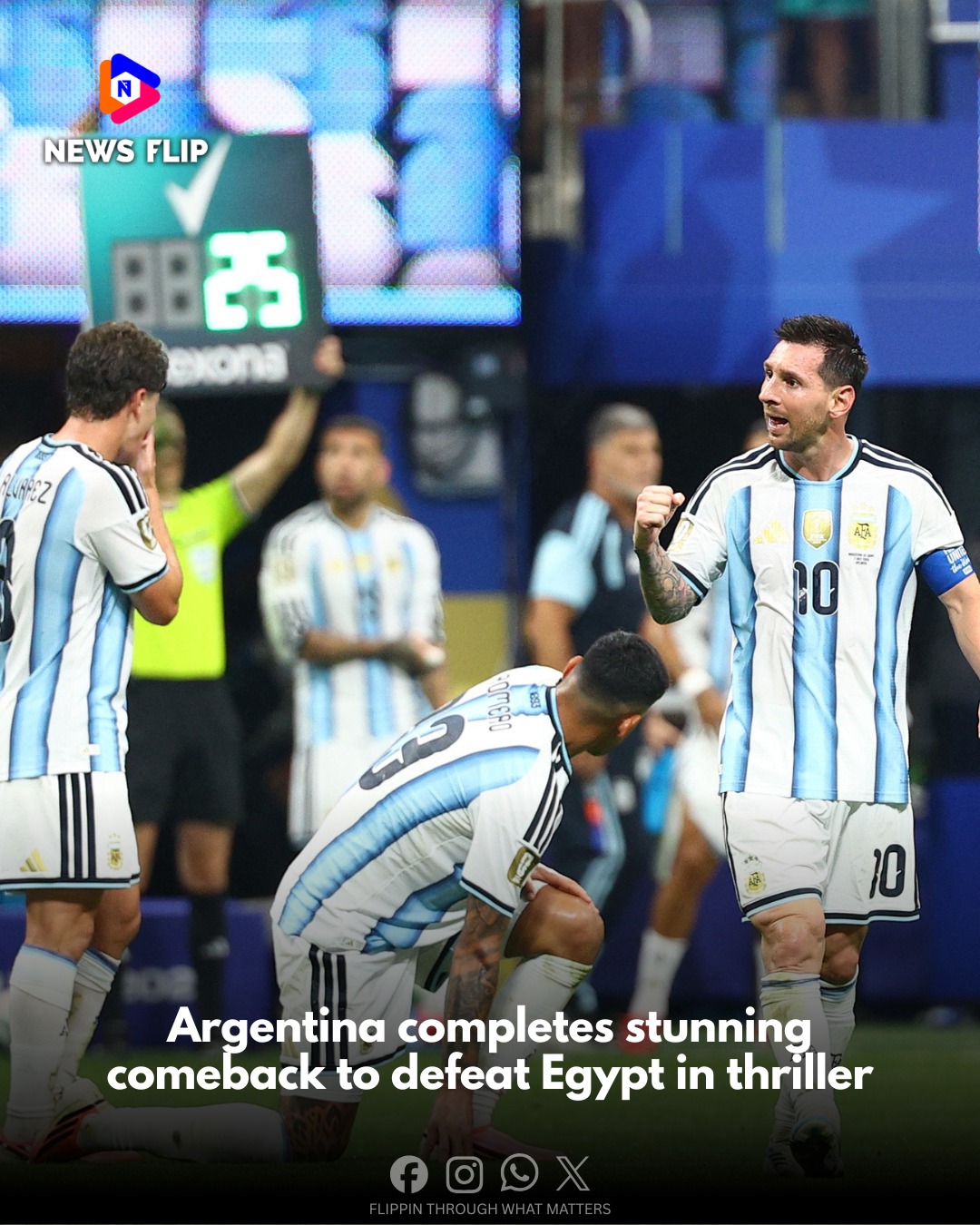
Argentina 3-2 Egypt Recap: Model Signals and Risk
Argentina rallied from 2-0 down to beat Egypt 3-2 in a World Cup round of 16 epic, exposing model risk and late-game volatility.
Argentina’s 3-2 comeback over Egypt was the kind of World Cup recap that punishes any model built only on pre-match control metrics. The defending champions trailed 2-0 at Mercedes-Benz Stadium after Yasser Ibrahim’s 15th-minute header and Mostafa Zico’s 67th-minute counterattack finish, then flipped the game with three goals in the final 11 minutes: Cristian Romero in the 79th, Lionel Messi in the 83rd and Enzo Fernández in stoppage time. For ScorePoint AI readers, the key takeaway is not just the scoreline — it is how Argentina’s late attacking volume and Egypt’s deep retreat created a high-risk finish that models must weight more heavily than early-game dominance.
Argentina 3-2 Egypt Recap
Argentina entered the round of 16 as the defending champions and left with a quarterfinal place, but only after one of the tournament’s wildest swings. Egypt had already been warned by a disallowed third goal following VAR intervention, and that moment mattered: at 2-0, the match was on the edge of being decided by game state rather than open-play balance. Instead, Argentina’s pressure kept building. Messi hit the post while the score was 1-0, then missed a first-half penalty when Egypt goalkeeper Mostafa Shobeir saved low to his left. The missed spot kick was the clearest sign that Argentina’s process was strong even when the result was not.
The turnaround also reinforced a pattern that has followed Argentina across this World Cup: the team can survive phases of tactical mess because its finishing upside is elite. Messi finished with his eighth goal of the tournament and a record-extending 21st World Cup goal, while Fernández’s stoppage-time winner capped a comeback that felt unlikely until the final minutes. Lionel Scaloni’s side now moves on to face Switzerland or Colombia in Kansas City on Saturday.
Egypt’s Tactical Risk
Egypt’s plan was brave, but it came with a ceiling. Yasser Ibrahim attacked Marwan Attia’s cross to beat Lisandro Martínez for the opener, and Mostafa Zico punished Argentina on the break for 2-0. That sequence showed exactly where Egypt could hurt the champions: direct service and transitions into space before Argentina’s back line was set. For 67 minutes, that approach worked.
The problem was the final phase. Once Egypt lost control of territory, it had to defend repeated waves from Argentina without enough relief through possession. The video-review disallowed goal was a warning that the back line was already being stretched. After Romero’s header reduced the margin, Egypt’s structure became more passive, and passive defending against Argentina is dangerous because the team can generate chances through both set pieces and sustained box pressure. That is where the tactical risk became visible in the recap.
Messi And The Margin
Messi’s individual line remains central to any World Cup analysis of Argentina. He did not score from the spot, hit the post, and still finished as the match’s defining player. That is the profile modelers should care about: high involvement, repeat chance creation, and resilience after variance in finishing. His 83rd-minute equalizer turned the match from unlikely to live, and Fernández’s winner arrived only because Egypt had been forced to defend deeper and deeper.
Argentina’s late push also fits its tournament identity. Julían Álvarez said the side “never gives up,” while Fernández called it a “phenomenal group” that stays together through adversity. Those comments match the game state data: trailing 2-0 with 11 minutes left, Argentina still generated enough pressure to score three times. The recap is not that Messi saved the match alone; it is that Argentina created enough late volume for one elite finisher after another to matter.
What ScorePoint AI Should Watch
For future AI predictions, this game is a reminder to separate stable team strength from volatile game-state spikes. Argentina’s pre-match signal was not “safe” in the way a 3-2 comeback may suggest. Instead, the winning edge came from three repeatable ingredients:
- Late shot generation after the opponent drops deeper.
- Set-piece threat, highlighted by Romero’s header.
- Elite conversion talent, even after a missed penalty and an earlier effort off the post.
Egypt’s signal was also clear: it can create danger in transition, but once forced into a low block for long stretches, its margin shrinks quickly. That matters in future analysis because teams that score first against Argentina will still need enough possession to slow the tempo, not just one clean counterattack.
One broader trend is worth noting in a World Cup recap like this: knockouts reward teams that can survive bad minutes and still produce decisive actions. Argentina did that here, and the comeback against Egypt strengthens the case that its floor in elimination football is higher than its first 67 minutes suggested. The practical outlook is straightforward — Argentina advances with momentum, but its path forward will depend on whether it can avoid needing another late rescue.
Research references
These sources were checked while preparing this ScorePoint AI analysis.