Dundee United vs Dundee: Numbers Behind Derby Margins
Dundee United vs Dundee derby analysis using xG, home advantage, discipline and score simulations to identify the fine margins behind a cautious Premiership contest.
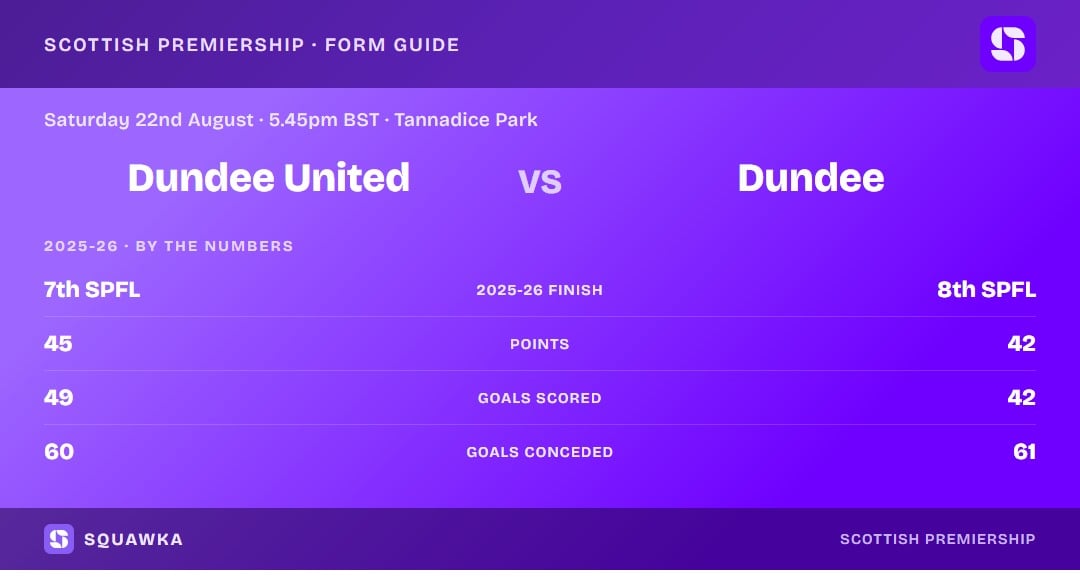
Dundee United vs Dundee is scheduled for Saturday 22 August 2026 at 5.45pm at the Calforth Construction Arena at Tannadice Park, with the rearranged Scottish Premiership fixture selected for live television. The occasion is intense, but the public pre-match data is not yet deep enough to justify a confident call on either side. That gap is precisely why this Dundee derby is a useful test of disciplined, probability-led analysis.
Dundee Derby Context
The fixture arrives in round three of the 2026/27 William Hill Premiership season. Dundee United open their campaign at home to Rangers on 31 July, while Dundee begin away to Celtic on 3 August. Those opening assignments matter for interpretation: both clubs face high-level opposition before meeting each other, so early league positions, goal difference and raw win-loss records could be heavily shaped by schedule strength.
There are no verified 2026/27 league positions, points totals, recent scores or head-to-head figures in the available research. A serious Dundee United vs Dundee analysis should therefore avoid turning reputation or one headline result into a supposed trend. The derby’s emotional importance is real, but it is not a substitute for shot quality, territory or confirmed availability.
Why Recent xG Matters
Recent expected goals should carry more weight than raw results in this fixture. A 1-0 win built on 1.8 xG tells a different story from a 1-0 win produced from 0.5 xG and a single low-probability finish. The same distinction applies to defeats against Celtic or Rangers: conceding late after creating several clear chances is not equivalent to being dominated for 90 minutes.
For this Dundee derby preview, the useful inputs are each club’s rolling attacking and defensive xG, shots inside the penalty area, big chances and set-piece share across their latest competitive matches. Those figures should be adjusted for opponent quality. A model that treats Dundee United’s meeting with Rangers and Dundee’s trip to Celtic as ordinary league observations risks overstating weakness in both attacks.
- Chance creation: compare non-penalty xG per 90 rather than goals alone.
- Defensive control: track opponent xG and touches in the box, not merely clean sheets.
- Game state: separate performances before and after the first goal.
- Schedule strength: downweight early results against the league’s strongest sides.
Lineups And Discipline
Confirmed lineup data is not included in the available research, and no verified injury or suspension list is provided. That limitation is important. Naming individual players, managers or tactical changes without confirmation would add apparent detail without adding reliable information. The final model should wait for starting elevens and distinguish first-choice absences from routine rotation.
Discipline is another derby-specific uncertainty control. A high-card match can change the expected score through an early booking, a second yellow or a penalty concession, but historical derby emotion alone cannot establish that this game will be unusually physical. The relevant evidence is each team’s recent fouls, cards, penalties conceded and disciplinary record by position. Until those numbers are available, discipline should widen the uncertainty range rather than create a directional prediction.
Low-Margin Score Simulation
ScorePoint AI’s analytical lens is most useful when it converts those inputs into a distribution rather than a single headline prediction. If the adjusted xG ratings for Dundee United and Dundee are close, the most common simulated outcomes are likely to cluster around narrow scorelines: 0-0, 1-0, 0-1 and 1-1. That does not mean a derby cannot produce a three-goal swing; it means the baseline probability is concentrated in outcomes decided by one moment.
Home advantage gives Dundee United a meaningful variable at Tannadice, but it should not be treated as an automatic win signal. The model should estimate the venue effect from league-wide home performance and then reduce confidence if the clubs’ underlying chance numbers are similar. In a close matchup, a modest home boost can move a 1-1 scoreline toward 1-0 without creating a large separation between the teams’ overall win probabilities.
The same logic explains why a cautious total-goals outlook may be preferable to a result-first narrative. When both attacks have uncertain early-season baselines and the score simulation is concentrated on 0-0 through 1-1, the probability mass favours a low-margin contest. That conclusion is conditional, not a claim that the derby must be quiet: confirmed lineups, goalkeeper changes or a major xG gap could materially alter it.
Practical Outlook
The best Dundee United vs Dundee analysis should be updated in three stages: establish opponent-adjusted xG after the opening fixtures, apply Tannadice’s measured home effect, then recalculate once lineups and disciplinary information are confirmed. Readers should compare probabilities across several narrow scores instead of reacting to the rivalry or early results alone.
With the currently available evidence, the responsible outlook is uncertainty first: a close match, a strong need for lineup confirmation and a plausible concentration around low-margin scores. The derby creates noise; the numbers should determine how much confidence survives it.
Research references
These sources were checked while preparing this ScorePoint AI analysis.