Lugano 4-1 St. Gallen: Super League Recap
Lugano beat St. Gallen 4-1 in a statement Super League win. Here is what the pre-match data, tactical risk and model signals reveal next.
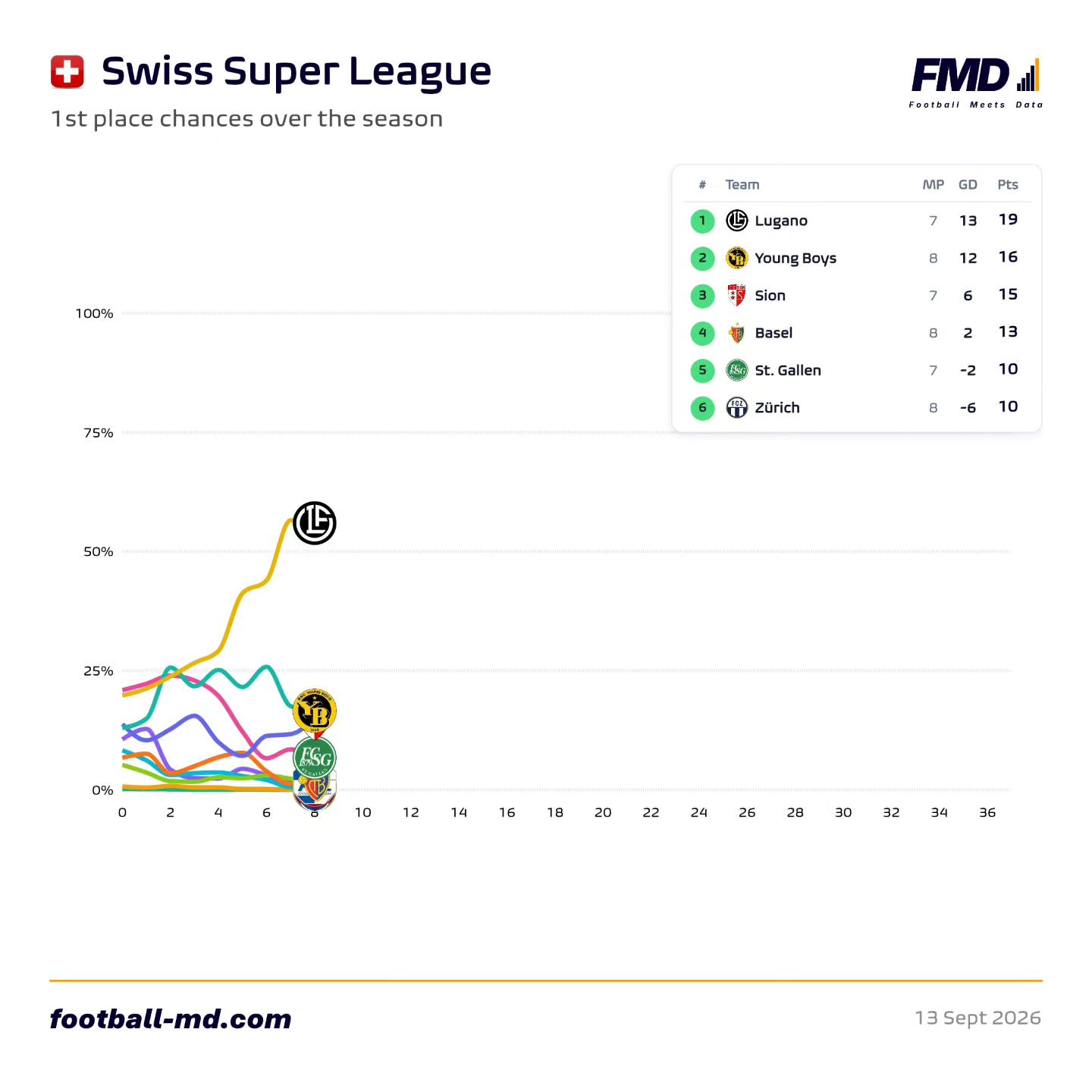
Lugano turned a favourable pre-match profile into a decisive 4-1 Super League victory over St. Gallen, producing the kind of result that strengthens its position at the top of the early title picture. The margin mattered as much as the three points: Lugano’s unbeaten start was built on control and defensive stability, but this recap shows a more aggressive edge against a St. Gallen side whose underlying numbers had already pointed to volatility.
Lugano’s Model Signals Confirmed
The pre-match data made Lugano the clearer statistical side. Mattia Croci-Torti’s team entered the fixture with six wins and one draw from seven league matches, 19 goals scored and only six conceded. St. Gallen, by contrast, had three wins, one draw and three defeats, with a negative goal difference of 12-14.
That gap became difficult to ignore at 4-1. Lugano had been averaging 2.6 goals, 6.4 shots on target and 16.6 total attempts per match. Its opponents had managed only 1.0 goal per game. St. Gallen offered greater attacking volume, averaging 19.9 attempts, but its defensive record showed the cost of that ambition: 1.7 goals conceded per match from 4.4 opposition shots on target.
For a predictive model, that is an important distinction. St. Gallen’s high shot volume suggested attacking intent, but Lugano’s superior chance prevention created the more reliable baseline. ScorePoint AI readers should treat the 4-1 result as confirmation that efficiency and defensive resistance outweighed raw possession or attempt counts in this matchup.
Tactical Risk Decided the Game
Both teams were projected to use a 3-5-2, creating a tactical contest built around wing-back positioning and midfield numbers. That shape can provide width and overloads, but it also leaves space behind advanced wide players when possession is lost. Lugano’s stronger defensive numbers meant it could accept that risk more comfortably than St. Gallen.
The pre-match lineup data also highlighted the different attacking profiles. Lugano had Kevin Behrens on four league goals, with Yanis Cimignani and Dereck Moncada on three apiece, while Anto Grgic had supplied four assists. St. Gallen’s leading scorers—Aliou Balde, Nevio Scherrer and Lukas Goertler—had three each, with Chima Okoroji contributing three assists. The 4-1 scoreline suggests Lugano’s broader threat base was more decisive than St. Gallen’s reliance on a smaller group of contributors.
That is the tactical lesson from this analysis: an aggressive shape is not automatically a problem, but it becomes dangerous when the opponent can attack the spaces it creates and still protect its own penalty area. Lugano had already conceded just four goals in its first six matches before drawing 2-2 with Young Boys. The four-goal response against St. Gallen showed that the draw had not altered its underlying attacking momentum.
St. Gallen’s Warning Signs
St. Gallen’s recent profile contained clear risk markers before kickoff. Enrico Maassen’s side had just lost 3-0 at home to Sion, despite recording 55% possession and six shots on goal. Possession did not translate into control, and the Lugano defeat extended that concern against a stronger opponent.
The head-to-head record offered St. Gallen encouragement: it had not lost in the previous eight meetings and had won the last clash 2-1 away at Lugano. However, historical results could not fully offset the current league split. Across the previous 10 meetings, St. Gallen had five wins, Lugano two and three matches had ended level. The latest 4-1 result is therefore a significant correction to the recent narrative, not merely another routine home success.
What the Next Predictions Should Track
The practical takeaway from this Super League recap is to monitor whether Lugano’s defensive floor remains intact when its wing-backs and midfielders push forward. The team’s early-season record—19 goals for and six against—supports continued confidence, but the 2-2 draw with Young Boys showed that even the league leader can be exposed by a high-quality transition attack.
- Lugano: track whether Behrens, Cimignani and Moncada continue to provide multiple scoring routes rather than relying on one finisher.
- St. Gallen: focus on defensive shots conceded and goals allowed, not possession alone. Its 19.9 attempts per match have not prevented a 14-goal concession total.
- Both teams: assess lineup continuity in the 3-5-2, especially the protection offered behind the wing-backs.
Lugano 4-1 St. Gallen was a statement win because it aligned the result, the margin and the pre-match data. The next useful test for any model will be whether Lugano can reproduce that attacking efficiency against opponents capable of matching its defensive discipline, while St. Gallen must prove that its high-volume approach can produce control rather than open games.
Research references
These sources were checked while preparing this ScorePoint AI analysis.