PSG vs Arsenal Champions League Final: What Decides It
PSG vs Arsenal in the Champions League final comes down to midfield control, full-back matchups, and who handles the moment at Budapest.
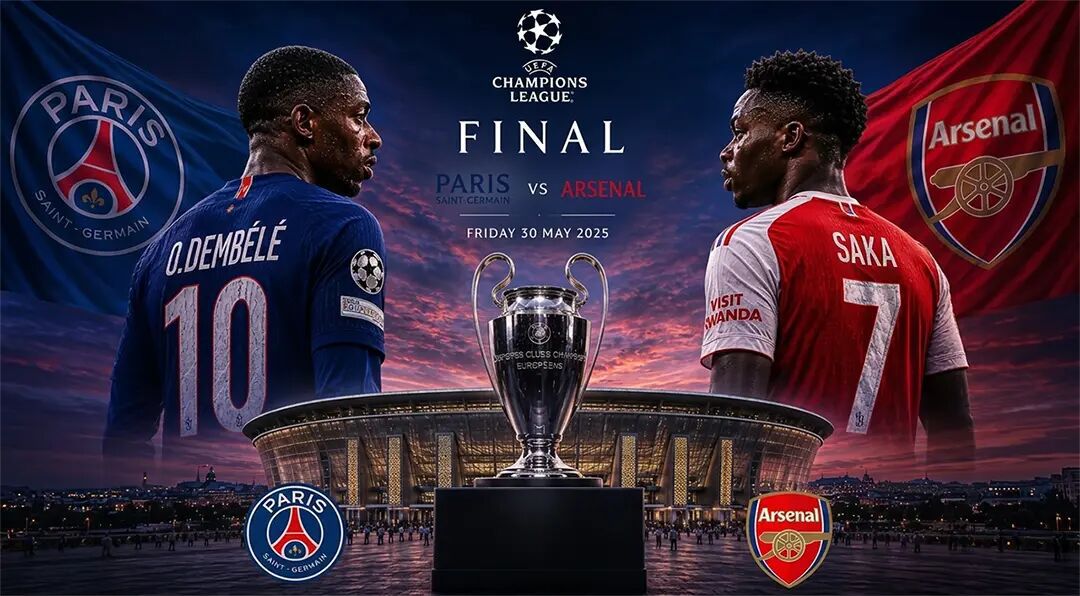
The Champions League final in Budapest brings together two clubs chasing different kinds of history: Paris Saint-Germain aiming to become the first team since Real Madrid’s 2016-18 run to retain the European crown, and Arsenal trying to win their first ever Champions League title after reaching only their second final. The PSG vs Arsenal Champions League final is not just a clash of elite squads; it is a tactical puzzle built around injuries, pressing traps, and the stress of one huge night. The margins are tiny, but the deciding factors are already visible in the lineup clues, the recent semi-final paths, and the way both teams have handled pressure all season.
PSG vs Arsenal Final Stakes
Arsenal arrive having already ended a 22-year wait for a Premier League title, which changes the emotional temperature of the night. Mikel Arteta’s side beat Atletico Madrid to book this final and have shown the kind of defensive control that carried them through a difficult European run, including victories over Bayer Leverkusen and Sporting. PSG, meanwhile, have already proven they can survive chaos in this competition, especially in the semi-final against Bayern Munich, where they won a breathless first leg 5-4 at the Parc des Princes before advancing through a tie that showcased their attacking ceiling.
The PSG vs Arsenal final also carries last season’s history into the room. These teams met in the semi-finals of the previous campaign, with PSG winning 3-1 on aggregate after a 2-1 second-leg victory in Paris. Before those wins, the head-to-head record featured three draws and two Arsenal victories, so this rivalry still feels open even if PSG have recent control of the matchup. That makes the final more than a rematch; it is a test of whether Arsenal can solve the same problems that repeatedly frustrated them a year ago.
Midfield Decides PSG vs Arsenal
The biggest tactical battleground in the PSG vs Arsenal Champions League final is central midfield. Luis Enrique is expected to lean on João Neves and Vitinha, with Fabián Ruiz likely to complete the trio if he proves ready after an on-and-off injury run over recent months. That combination gives PSG passing range, ball security, and the ability to attack space between the lines, especially when Khvicha Kvaratskhelia and Désiré Doué drift inside from the front three.
Arsenal’s issue is that Arteta has selection questions deeper than just one role. The line most likely to start has Declan Rice alongside Myles Lewis-Skelly, with Martin Ødegaard ahead of them, but the balance of that unit depends on how much help the full-backs can provide. If Arsenal are too cautious, PSG’s midfielders will dictate territory. If Rice steps out aggressively, he can disrupt Vitinha’s rhythm, but he also opens pockets behind him for Ousmane Dembélé and Kvaratskhelia to exploit. That is why this preview keeps returning to the same idea: the final may be won by the team that controls the middle third for longer periods, not by the one that dominates possession outright.
Full-Back Matchups Matter
Few positions in the PSG vs Arsenal final look as exposed as right back. Achraf Hakimi has been nursing a hamstring tear and is unlikely to feature from the start, which leaves Warren Zaïre-Emery as the most logical replacement if PSG do not risk their star defender. That is a significant shift because Hakimi’s recovery runs and width are a major part of PSG’s attacking shape. Even so, Zaïre-Emery brings composure and enough defensive intelligence to keep the structure intact.
On Arsenal’s side, Jurrien Timber and Ben White may both be unavailable, leaving Cristhian Mosquera in a difficult one-vs-one battle with Kvaratskhelia. That duel could define the final more than the headlines suggest. Kvaratskhelia’s direct running, combined with Dembélé’s movement and Doué’s ability to attack the half-space, creates repeated overloads on the same flank. If Arsenal cannot protect Mosquera, then Saliba and Gabriel will be forced to shift across constantly, which weakens the team’s central defensive base.
The left side is also loaded with pressure. Nuno Mendes is expected to recover from a thigh injury and could start for PSG, giving Enrique a full-time outlet to push Arsenal back. That would force Bukayo Saka, who is set to start, to work deeper than he would like. If Saka spends too much energy defending, Arsenal lose one of their best transition weapons before they can even attack.
PSG Attack vs Arsenal Defence
The most obvious contrast in the PSG vs Arsenal Champions League final is the collision between PSG’s fluid front three and Arsenal’s centre-back pairing. William Saliba and Gabriel have been the foundation of Arsenal’s European run, and they should cope in the central channels against direct pressure. But this is where PSG’s variety becomes so dangerous: Dembélé can stretch the line wide, Doué can carry the ball through pressure, and Kvaratskhelia can isolate defenders in space before cutting inside.
PSG’s attack looked explosive in the 5-4 semi-final first leg against Bayern Munich, and although a final rarely opens up like that, the semifinal still matters because it revealed the team’s level when games become stretched. PSG can score in clusters when opponents lose their spacing. Arsenal, by contrast, have leaned on control, structure, and the ability to reduce the game to one or two high-value chances. That is why the first goal matters so much. If PSG score early, the match could become a test of Arsenal’s reaction. If Arsenal survive the opening wave, the pressure swings back toward PSG to force the issue.
This dynamic is similar to what was seen in the Paris Saint-Germain 1-1 Arsenal Champions League recap, where neither side allowed the other to fully settle. The same defensive tension is likely to shape the final, only with much higher stakes and far less room for error.
Big-Match Experience
The PSG vs Arsenal preview is also a story about experience under pressure. PSG are defending champions and have already lived through the emotional weight of a final. That matters when the match enters the final 20 minutes and decisions become less about tactics and more about nerve. Marquinhos, still the anchor of the back line, provides that calm. So does Vitinha, whose ability to keep the ball moving can slow Arsenal’s pressing bursts.
Arsenal, though, have their own form of pressure release. Arteta’s side have won the Premier League for the first time since 2004, so the final is not carrying the burden of an entire season’s worth of failure. They also progressed through Europe by showing resilience in tight games, and that profile should not be ignored. In a one-off final, the team that can stay emotionally level after a setback is often the team that survives.
That is why this should be a detailed, tactical analysis rather than a simple question of reputation. Arsenal’s structure gives them a chance. PSG’s talent gives them a higher ceiling. The title may come down to whether Arsenal can keep the match compressed long enough to make it a chess game, or whether PSG can turn it into a series of short, sharp transitions.
What Decides It
Three factors will likely decide the PSG vs Arsenal Champions League final: midfield control, full-back availability, and the first goal. PSG have the more varied attacking toolbox, especially if Dembélé, Doué, and Kvaratskhelia all start together behind a functional midfield. Arsenal have the cleaner defensive spine, but the fitness concerns around Timber, White, and the right side of the back line could make that advantage less secure than usual.
The most likely script is a tense opening phase, a long tactical standoff, and then one moment where either PSG’s creators find a lane or Arsenal’s defensive line holds firm and springs Saka or Ødegaard the other way. That is what makes the biggest game in Europe so compelling: neither side needs chaos, but both have the players to create it. For more match analysis and data-led football insight, ScorePoint AI offers AI predictions and an AI assistant that can help break down lineups, matchups, and in-game swings in real time.
For readers following the wider European run-in, the tactical themes in this final echo those seen in the PSG vs Arsenal Champions League Final Preview and the earlier Paris Saint-Germain vs Arsenal: Champions League Preview, where the same central questions already stood out: can Arsenal contain PSG’s width, and can PSG stop Arsenal from turning the final into a controlled, low-event contest? The answer will shape the trophy.