Russia 3-0 Trinidad and Tobago Friendly Recap: Clinical Win
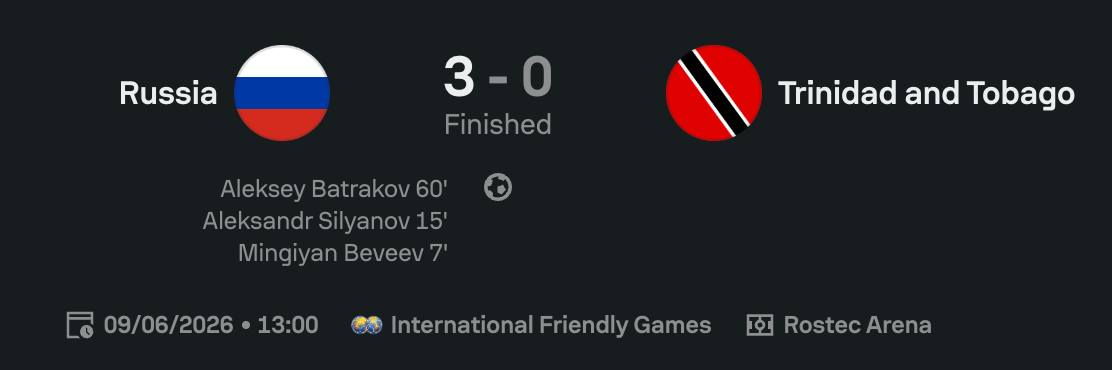
Russia beat Trinidad and Tobago 3-0 in a controlled friendly, with a first-half breakthrough and a professional finish in the second period.
Russia produced a polished 3-0 friendly international recap against Trinidad and Tobago, turning a disciplined start into a comfortable victory through sustained pressure, cleaner finishing and control after the interval. In a match that fit the profile of a tune-up more than a sprint, Russia did the simple things well: they moved the ball quickly, forced Trinidad and Tobago deep, and avoided the kind of sloppiness that can undermine a home-friendly performance. The result leaves Russia with a confidence-building win, while Trinidad and Tobago were left chasing the game for long stretches without enough final-third threat to change the momentum.
For a side looking to sharpen its edges in a preparatory setting, this was the sort of Russia 3-0 Trinidad and Tobago result that can matter beyond the scoreline. The hosts established territorial superiority early, then increased the pace after finding the opening goal. Trinidad and Tobago stayed compact for long periods, but they struggled to deal with Russia’s width, second-phase attacks and pressure around the box, which eventually made the margin look deserved rather than flattering.
Russia Take Early Control
The opening phase of the match was defined by Russia’s possession and positional discipline. Rather than forcing the issue centrally, they worked the ball across the width of the pitch and tried to pull Trinidad and Tobago’s defensive block from side to side. That approach produced repeated entries into advanced areas and created the sort of pressure that often precedes goals in international friendlies, where rhythm can be more important than pure intensity.
Russia’s breakthrough shifted the game immediately. Once ahead, they were able to play with more confidence and less urgency, while Trinidad and Tobago had to advance their lines. That opened space for Russia to attack between the lines and create cleaner chances than they had in the opening stages. The pattern was familiar: the team in control of territory eventually converted that control into a decisive lead.
The match also reflected a broader theme seen across recent friendlies, where organized European sides have used warm-up fixtures to establish structure and tempo. Russia’s performance echoed the controlled efficiency that helped other teams post convincing tune-up wins, such as Hungary’s 3-1 win over Kazakhstan and Togo’s 5-1 derby victory over Benin.
Trinidad and Tobago Struggle Forward
Trinidad and Tobago’s biggest issue was not simply defending their box, but getting enough relief once they won possession. Too many attacks broke down before they could establish sustained pressure, leaving Russia free to recycle the ball and attack again. As the match wore on, that imbalance became increasingly difficult to manage.
Even when Trinidad and Tobago resisted in deeper areas, they rarely turned that resistance into forward momentum. Russia’s structure out of possession forced them into low-value passes, and that in turn reduced the chance of dangerous transitions. The result was a familiar friendly dynamic: one side controlling the rhythm, the other side chasing phases without ever fully resetting the contest.
That is where the analysis of this friendly international recap becomes important. A 3-0 scoreline is not just about finishing; it is often a reflection of repeated field position, ball retention and the ability to prevent counterattacks. Russia were superior in all three categories, and Trinidad and Tobago never managed to create the long spell of pressure they needed to force uncertainty.
Clinical Second-Half Finish
After the interval, Russia did what stronger teams often do in friendlies: they simplified the game and stayed patient. Instead of chasing a fourth or trying to force individual moments, they kept probing until the defensive cracks widened. That approach produced the third goal and closed the contest for good.
The second-half pattern was especially important because it showed Russia could maintain control without slipping into complacency. Friendlies can become messy once the scoreline is secure, but Russia kept their spacing, denied Trinidad and Tobago a route back into the match and managed the closing stages with the maturity expected of a side playing at home and on top.
For Trinidad and Tobago, the lesson was less about the final score and more about the gap in execution. They competed, but they did not carry enough threat to disrupt Russia’s rhythm. Without a sustained counterattacking outlet or a set-piece breakthrough, the match moved steadily away from them.
What Russia Learned
There were clear positives for Russia from this Russia 3-0 Trinidad and Tobago recap. First, they showed that they can control a match without needing chaos or high-risk attacking sequences. Second, they were patient enough to break down a compact opponent. Third, they converted enough of their territorial advantage to make the scoreline reflect the flow of play.
That makes the performance useful in a broader preparation context. Teams entering international windows want clarity more than spectacle, and Russia got both a clean sheet and a three-goal cushion. The structure of the victory also mirrors other efficient warm-up results across the schedule, including Spain’s 3-1 win over Peru, where control and finishing quality made the difference.
- Scoreline: Russia 3-0 Trinidad and Tobago
- Match type: Friendly international
- Key theme: Russia controlled possession and tempo
- Decisive factor: Trinidad and Tobago could not sustain pressure after conceding
Friendly Recap, Bigger Picture
In the end, this was a straightforward friendly recap built on competence rather than drama. Russia were the better side from start to finish, and their 3-0 win was the product of organized buildup, sharp territorial control and a composed second-half finish. Trinidad and Tobago competed hard, but they spent too much of the match reacting to Russia rather than shaping it.
If you want to turn performances like this into sharper readouts for upcoming fixtures, ScorePoint AI’s AI predictions and AI assistant can help break down team form, match patterns and likely game states. For readers following the wider international schedule, this result fits neatly alongside other recent warm-up evaluations on ScorePoint AI, where detail-driven analysis is just as important as the scoreline itself.
Russia will take confidence from a professional night, while Trinidad and Tobago will look for a faster attacking response in their next outing. In international football, especially in friendlies, the best sign is often the simplest one: controlling the game, scoring three, and leaving little doubt about the result.
/https%3A%2F%2Fsportsmole-media-prod.s3.gra.io.cloud.ovh.net%2F24%2F36%2Feldor-shomurodov.jpg)