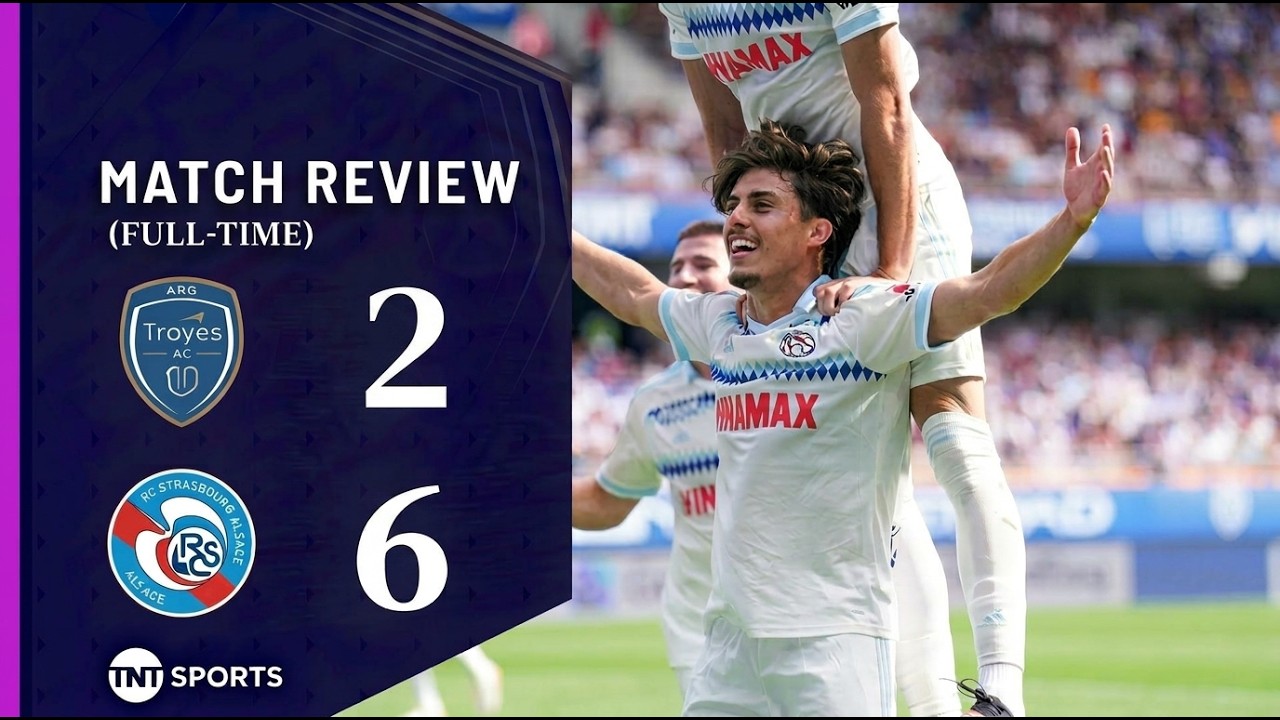
Troyes 2-6 Strasbourg: Ligue 1 Shootout Explained
Strasbourg turned a narrow pre-match model lean into a 6-2 Ligue 1 rout at Troyes. Here is what the score means for future AI predictions.
Strasbourg transformed a cautious pre-match prediction into a statement victory, beating Troyes 6-2 in an eight-goal Ligue 1 shootout. The public preview had pointed to a tight 2-1 Strasbourg win, but the visitors’ attacking efficiency and Troyes’ defensive exposure produced a far wider margin. Jacobo Ortega, Diogo Sousa, Giovanni Reyna, Sam Amo-Ameyaw and Conrad Harder were all on the scoresheet, with Amo-Ameyaw striking twice. Troyes’ late consolation goals could not disguise a major collapse after the match turned.
Troyes 2-6 Strasbourg Recap
The result was particularly striking because the pre-match table suggested a much closer contest. Troyes began the fixture sixth with four points from two matches and only one goal conceded, while Strasbourg were 10th with three points and had already conceded five times. The early data therefore offered reasons to respect Troyes’ defensive start, even though Strasbourg remained the stronger projected side.
That defensive profile lasted only briefly. Strasbourg recovered from conceding early and turned the match around before half-time. Ortega equalised in the 40th minute, followed by Sousa two minutes later. Reyna then extended the advantage in the 57th minute. Amo-Ameyaw added two late goals, and Harder completed the six-goal haul in stoppage time. Troyes did score a second late goal, including a 90+5-minute strike from Jérémy Le Douaron, but the damage was already complete.
Model Signals Versus Match Reality
The most useful analytical point is not that a model missed the exact score. A 1-2 prediction correctly identified Strasbourg as the likely winner and anticipated goals for both teams, but it underestimated the match’s volatility. Both teams had scored in each of the previous five Ligue 1 meetings, a clear signal that this fixture could become open once the first goal arrived.
The 6-2 scoreline also shows why result predictions and margin predictions should be separated. Strasbourg’s pre-match league record was modest—one win and one defeat, with two goals scored and five conceded—but their starting XI contained several players capable of exploiting a stretched game. Reyna operated behind Ortega, while Nanasi and Gessime Yassine supplied width and movement. Once Troyes had to chase, the space around their midfield and defensive line became increasingly valuable to Strasbourg.
The public research does not provide xG, shot totals or possession figures, so the size of the victory should not be treated as proof that Strasbourg dominated every phase. It does, however, confirm a decisive outcome: six different attacking contributions, a successful comeback away from home and an eight-goal total that dramatically exceeded the conservative score forecast.
Tactical Risk Created Eight Goals
Troyes started in a 4-1-4-1, with Mouhamed Diop positioned at the base of midfield and Renaud Ripart leading the line. Strasbourg’s 4-2-3-1 gave them a natural numerical platform in central areas through Sousa and Pape Diop, while Reyna had freedom to connect midfield with Ortega.
That contrast mattered after the interval. Troyes’ single holding midfielder had to protect the centre while the four advanced midfielders supported Ripart. When the hosts fell behind, maintaining that shape required greater forward commitment. Strasbourg could then attack the spaces left behind, using Reyna’s positioning and the pace of Amo-Ameyaw, who finished with an 8.8 Sofascore rating. The lesson for future analysis is clear: a 4-1-4-1 can look compact before the match but become vulnerable when the score demands risk.
What Strasbourg Watch Next
For Strasbourg, this analysis should be treated as evidence of attacking upside rather than a complete correction of their defensive concerns. They arrived having conceded five goals in their first two league matches, yet scored six at Troyes. Future AI predictions should therefore weigh both sides of the profile: the finishing confidence shown by Ortega, Sousa, Reyna, Amo-Ameyaw and Harder, and the possibility that open games remain their preferred—and most dangerous—environment.
Troyes face the opposite question. Their opening record of four points from two matches and one goal conceded suggested a controlled start, but conceding six exposes how quickly that stability can disappear under sustained pressure. The next preview should focus on whether Patrick Beach’s defence can protect the centre without leaving Ripart isolated, and whether the midfield can manage transitions more effectively.
The practical takeaway from this Ligue 1 recap is to track the interaction between team strength and tactical risk. Strasbourg’s win validated the basic model direction, while the 6-2 margin highlighted the uncertainty around goal volume. That distinction will matter in future ScorePoint AI analysis and free-pick context: identifying the likely winner is one task; recognising when a fixture carries genuine shootout potential is another.
Research references
These sources were checked while preparing this ScorePoint AI analysis.