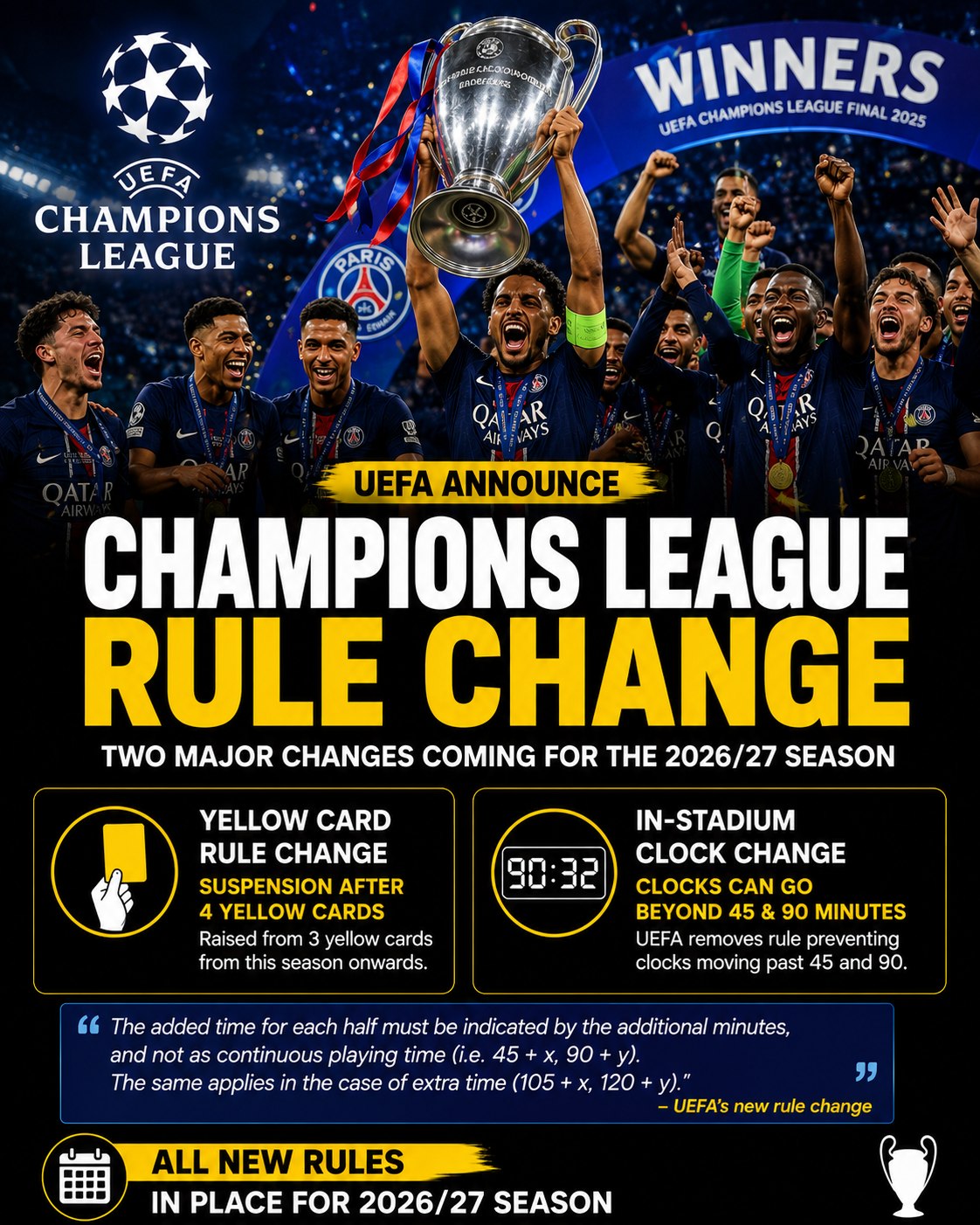
UEFA’s New Champions League Rules: 2026-27 Impact
UEFA’s 2026-27 Champions League rule changes affect suspension modelling and match data, but not extra time, penalties or qualification maths.
UEFA’s two confirmed rule changes for the 2026-27 Champions League will influence how clubs manage disciplinary risk, but they do not rewrite the competition’s qualification format or knockout mathematics. The first raises the initial yellow-card suspension threshold from three cautions to four. The second allows stadium clocks to continue beyond 45 and 90 minutes, displaying added time rather than stopping at the end of each half.
For a prediction model, the distinction matters. One change affects player availability; the other mainly affects communication and match interpretation. Neither should be treated as a direct reason to increase a favourite’s qualification probability or to change the expected likelihood of extra time.
Champions League Suspension Modelling
The move from a three-yellow threshold to four gives players an additional caution before serving their first one-match ban. That is most relevant in qualifying ties and the league phase, where a club may play several European matches in a compressed schedule. Celtic, drawn against LASK in the Champions League play-off round, provide a clear example of the type of tie where one unavailable starter can alter the second-leg forecast.
The practical modelling change is not to remove disciplinary risk, but to recalculate it. Historical Champions League data collected under the three-card threshold will otherwise overstate the frequency of first suspensions in 2026-27. ScorePoint AI should tag each historical absence by the rule environment and run a counterfactual: which players would have avoided suspension if the fourth-card threshold had applied?
- Player-level adjustment: separate normal injury and rotation absences from yellow-card bans.
- Squad-depth adjustment: reduce the penalty for accumulated cautions, particularly for clubs with reliable replacements.
- Schedule adjustment: apply more weight to suspension exposure across consecutive European fixtures rather than treating every match independently.
The effect will not be uniform. A starting central midfielder who regularly plays on the disciplinary edge carries more predictive significance than a fringe defender with limited minutes. A model should therefore use minutes, starts and role importance, not simply team-wide yellow-card totals. The new rule may also encourage some coaches to keep key players on the pitch in matches where they previously faced an imminent suspension, but that tactical response should be learned from 2026-27 data rather than assumed in advance.
What Changes for Qualification?
Qualification probabilities do not change because of the card threshold alone. The tie structure, aggregate scoring and the route into the league phase remain the decisive inputs. The change operates indirectly through line-up projections. If a model previously expected a leading midfielder to miss the second leg after receiving a third caution, that absence should no longer be built into the baseline unless the player reaches four.
This makes first-leg disciplinary events slightly less damaging to a club’s projected tie position. The effect should be largest in closely matched qualifiers, where a single starting-player absence can move the expected result more than it would in a mismatch. It should be smaller for elite squads such as Arsenal, Manchester City, Manchester United, Aston Villa and Liverpool, the five English clubs listed for the 2026-27 Champions League, because replacement quality reduces the marginal cost of suspension.
A sound Champions League analysis should therefore show both the football probability and the availability probability. The new rule changes the second component, not the underlying strength rating of either team.
Clocks, Added Time and Goals
Allowing clocks to move beyond 45 and 90 minutes does not add a new period of play. Referees still determine stoppage time, and the match does not become longer simply because spectators can see the clock continue. Consequently, historical goal rates, late-goal frequencies and extra-time projections should not receive a mechanical uplift.
The visible clock could influence behaviour at the margins. Players and coaches will have clearer information about how much added time remains, while trailing teams may push earlier and leading teams may manage restarts differently. Those are behavioural hypotheses, not established effects. Models should monitor late goals, substitutions and disciplinary events during the first half-season before assigning them predictive weight.
The distinction is especially important when reviewing a match recap. A goal shown at 90:04 under the new display convention is not evidence of a longer match than a goal recorded at 90:00 plus stoppage time under the old system. Historical event timestamps must be normalised before comparison.
Extra Time and Penalties Unchanged
Neither announced change alters extra-time rules or penalty shootouts. A tie that remains level after the prescribed two legs still follows the existing knockout procedure, and the penalty phase remains a separate high-variance state rather than an extension of normal-time strength ratings.
That separation should remain in any 2026-27 prediction pipeline. A model needs one probability for advancing in normal or aggregate play, another for reaching extra time, and a calibrated penalty-shootout component. The 2026 Champions League final, in which Paris Saint-Germain retained the crown after a shootout victory over Arsenal, is a reminder that penalty outcomes can decide the trophy without implying that one club dominated the underlying match process.
Practical Outlook for 2026-27
The new Champions League rules are meaningful, but narrow. Recode historical suspensions, update player-availability forecasts and avoid treating the running clock as a change to match duration. For close ties such as Celtic versus LASK, disciplinary scenarios deserve greater attention; for deep squads, the impact should be discounted. The best 2026-27 analysis will preserve historical goal and extra-time data while separating old suspension rules from the new four-card threshold.
Research references
These sources were checked while preparing this ScorePoint AI analysis.


