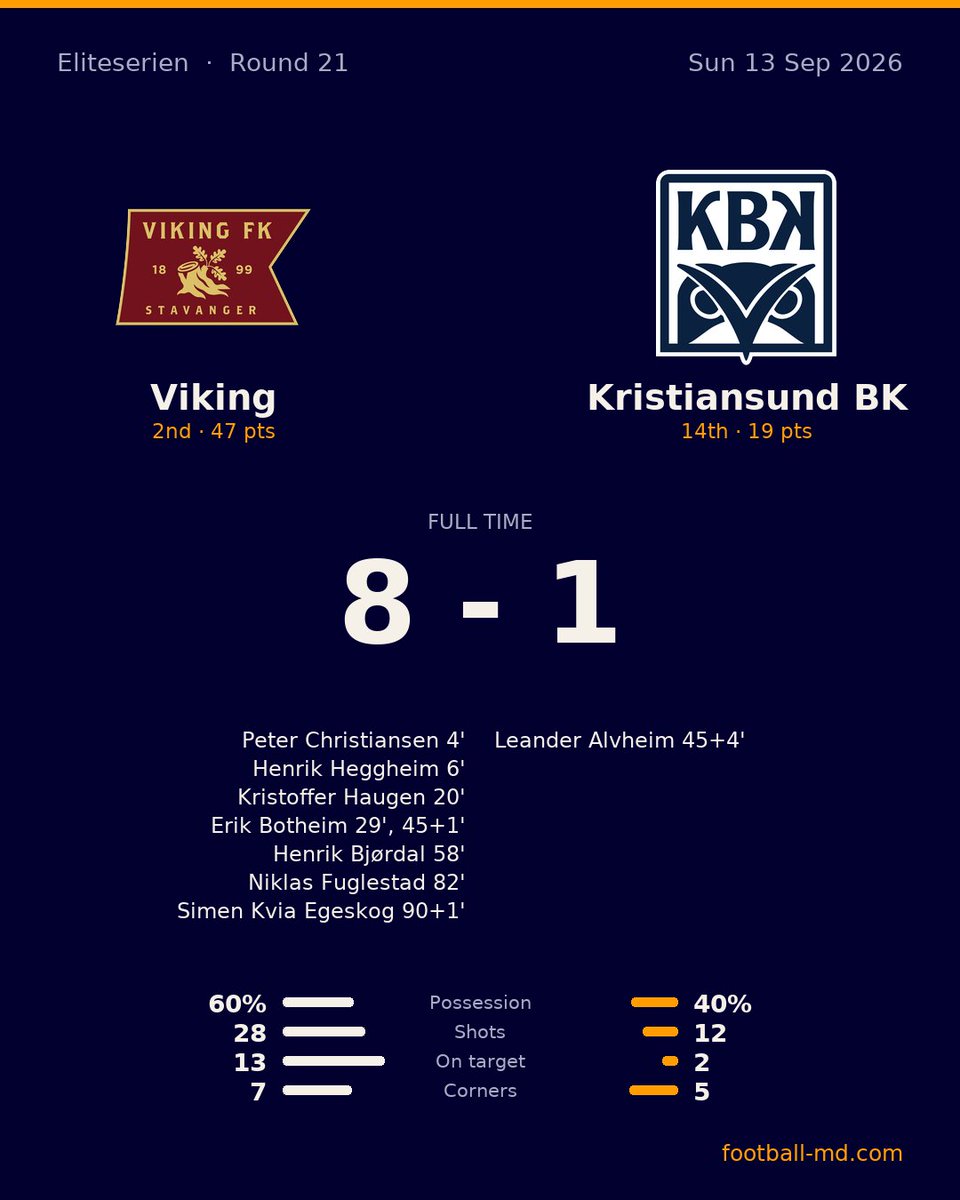
Viking 8-1 Kristiansund: Eliteserien Recap & Analysis
Viking demolished Kristiansund 8-1 in the Eliteserien. Here is what the model signals, tactical risks and next prediction angles reveal.
Viking FK turned a favourable Eliteserien matchup into an 8-1 statement win over Kristiansund, combining the league’s stronger pre-match profile with ruthless attacking efficiency. Peter Christiansen scored Viking’s opening goal, while the final margin moved the Stavanger side to 14 wins from 19 league matches in the available table snapshot.
Viking’s Pre-Match Edge
The underlying numbers already pointed clearly toward Viking. Before this result, Viking had 44 points from 19 matches, with 43 goals scored and 19 conceded. Kristiansund entered the fixture 13th on 19 points, having scored 19 and allowed 29. That 25-point gap was a stronger signal than league position alone: Viking averaged more than two goals per match, while Kristiansund’s negative 10 goal difference suggested a team vulnerable to sustained pressure.
The recent-form contrast was also meaningful. Viking’s last six listed results were draw, win, win, loss, win, draw; Kristiansund’s were loss, loss, win, loss, draw, win. A model weighing points, scoring rate and defensive record would have identified Viking as the stronger side. The 8-1 scoreline was extreme, but the direction of the result was consistent with those signals.
How the Match Broke Open
Public match data does not provide a complete event log or confirmed lineups, so the tactical reconstruction should remain narrow. The available snapshot recorded Kristiansund leading 1-0 in the 35th minute before Viking’s eventual turnaround, and reports identify Christiansen as the first Viking scorer. That sequence is important: Kristiansund showed it could punish an early lapse, but it could not protect the advantage once Viking increased the pressure.
The final corner count was only 7-5 to Viking, which makes the eight-goal margin more notable. Viking did not simply win through a huge set-piece volume advantage. The score instead points to superior finishing, transition execution or the ability to convert defensive errors after the game became stretched. The 0-1 card count also indicates that the match was not defined by disciplinary disruption.
For Kristiansund, the tactical risk was exposed after taking the lead. A lower-ranked side protecting a narrow advantage often has to choose between dropping deeper and continuing to press. Either approach can fail against a team with Viking’s scoring profile. Once Kristiansund lost control of midfield or the first defensive line, the match appears to have shifted from a contest into a sequence of high-value attacking situations.
What the Model Should Learn
The main lesson from this recap is not that an 8-1 result should become a new baseline. Extreme scorelines carry noise. The more useful signal is the interaction between Viking’s attacking rate and Kristiansund’s defensive concession rate. Viking had already scored 43 goals and conceded 19; Kristiansund had scored 19 and conceded 29. Those numbers supported a Viking win and made a multi-goal victory plausible, but they did not independently guarantee seven-goal separation.
- Prior strength: Viking’s 44 points versus Kristiansund’s 19 made the matchup structurally uneven.
- Goal environment: The teams combined for 62 goals scored and 48 conceded before this fixture across the available table data.
- State dependence: Kristiansund’s reported 1-0 lead shows that pre-match superiority does not remove early-game volatility.
- Regression risk: Viking’s next prediction should not automatically assume another eight-goal performance.
Kristiansund’s Warning Signs
Kristiansund’s position was not based on one poor afternoon. The table showed five wins, four draws and 10 defeats, with a minus-10 goal difference. Its recent sequence contained three losses in six matches, despite wins over the same period. That combination suggests a side capable of competing in isolated fixtures but less reliable across 90 minutes against stronger opponents.
The 8-1 defeat also changes the interpretation of future matchups. Prediction models should separate a genuine defensive trend from a single collapse by checking the next match’s shot volume, field position and goals conceded before halftime. Without those details in the public record, it would be excessive to assign the entire result to one formation or one player.
Eliteserien Outlook
For Viking, the practical takeaway is pressure at the top: the available standings placed them second, behind Bodø/Glimt’s 47 points, despite Viking’s 14-2-3 record. The win lifted their goal difference from plus-24 by seven goals, a potentially important secondary advantage in a close title race.
For future AI predictions and free-pick analysis, Viking should be assessed as a strong favourite when its scoring rate and opponent defensive record align. The disciplined approach is to treat this 8-1 Eliteserien recap as confirmation of a pre-match strength gap—not proof that every Viking fixture will become a shootout.
Research references
These sources were checked while preparing this ScorePoint AI analysis.