Wolves vs Aston Villa: West Midlands Derby Preview
Preview of Wolverhampton Wanderers vs Aston Villa West Midlands derby. Form, key players, tactical battle and outlook — analysis using recent match data and player stats.
The West Midlands derby returns as Wolverhampton Wanderers host Aston Villa in what promises to be a finely poised Premier League encounter. Wolves arrive on the back of mixed results — a 2-2 home draw with Arsenal on 18 February in which Santiago Bueno provided an assist and Tom Edozie scored, followed by a 1-0 defeat to Crystal Palace when Jérémy Guéssand’s late strike decided the game on 22 February. Villa bring a midfield identity shaped around Boubacar Kamara: when Kamara plays Villa concede 1.1 goals per game and win 61% of their matches, while without him the figures shift to 1.7 goals conceded and a 42% win rate.
Recent form
Wolverhampton Wanderers’ recent run is patchy and packed with low-scoring fixtures. Over the last five league outings recorded in February, Wolves drew 2-2 with Arsenal (18 Feb), beat a side listed as GRI 1-0 on 15 Feb, drew 0-0 with Nottingham Forest on 11 Feb, lost 3-1 to Chelsea on 7 Feb and lost 2-0 to Bournemouth on 31 Jan. That sequence highlights a side that can grind out results — the 0-0 at Nottingham Forest — but has also suffered heavy defeats against top-six opposition, notably the 3-1 reverse to Chelsea.
Aston Villa’s form narrative in the run-up to this derby is heavily correlated with one player. Defensive midfielder Boubacar Kamara provides the protection that has helped Villa concede just 1.1 goals per game and record a 61% win rate when he starts; absence of Kamara has seen that defensive output drop to 1.7 goals conceded per game and win percentage fall to 42%. That single statistical contrast frames much of Villa’s selection and tactical planning ahead of this West Midlands clash.
Key players to watch
- Santiago Bueno (Wolves, centre-back) — Bueno assisted in the 2-2 draw with Arsenal on 18 February and has been influential from the back, contributing to chance creation while also featuring in Wolves’ defensive work.
- Tom Edozie (Wolves, forward) — Edozie scored in the 2-2 draw with Arsenal and is one of Wolves’ more direct attacking outlets in the transition phases.
- Boubacar Kamara (Aston Villa, defensive midfielder) — Villa’s defensive metrics change dramatically depending on Kamara’s availability; his screening role is the single biggest determinant of Villa’s ability to keep games tight.
- Jérémy Guéssand (Crystal Palace) — Not a Villa player but relevant to Wolves’ recent form: Guéssand’s 90th-minute winner on 22 February inflicted a 1-0 defeat on Wolves, underlining issues Wolves have had closing out matches.
Tactical battles
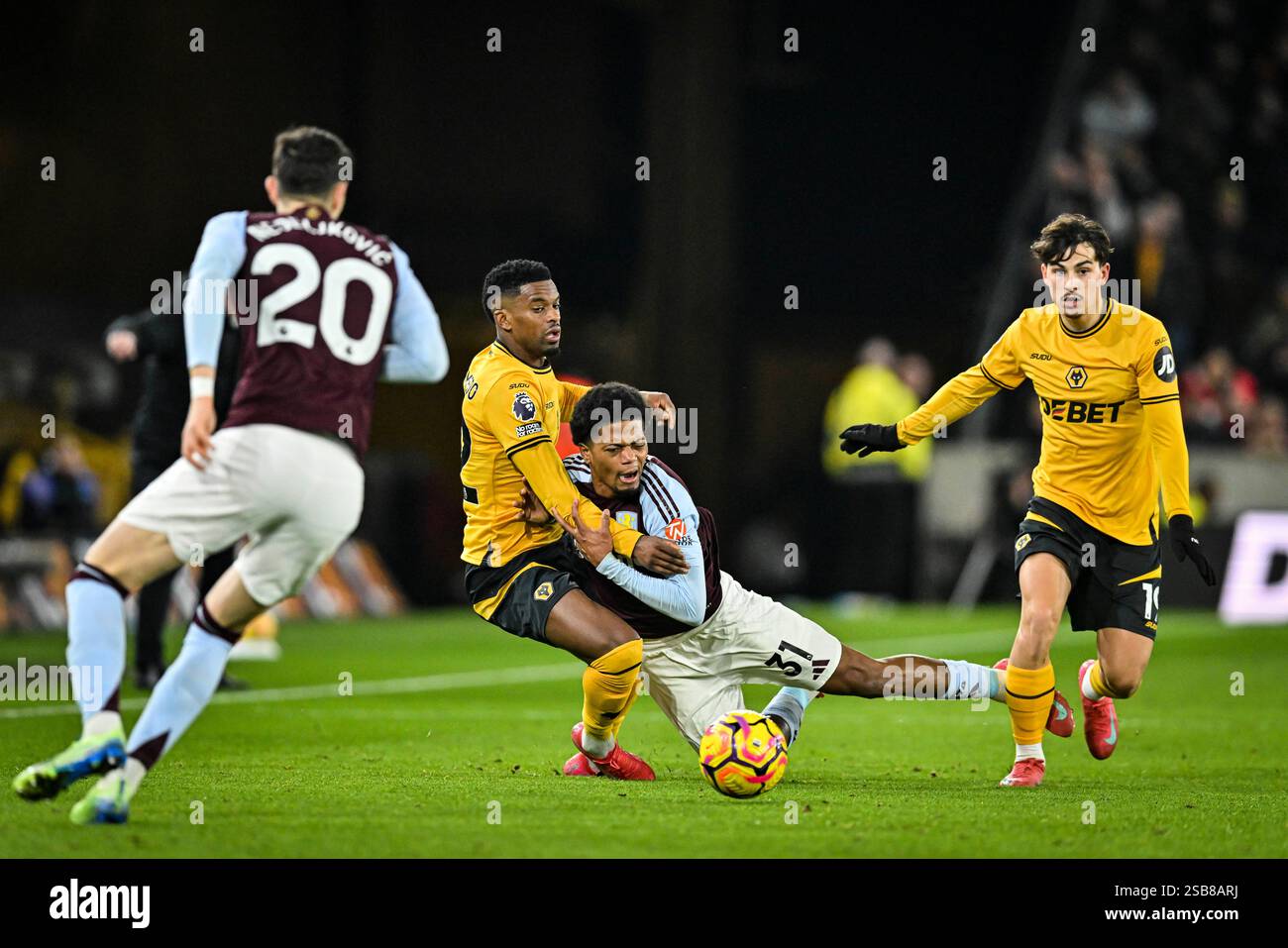
The duel in midfield is the match’s likely fulcrum. Villa’s structure flows through Kamara when he starts: his presence reduces the space Villa’s backline must cover and allows full-backs to advance. Wolves will need to target that channel if Kamara is absent or not at full sharpness — their recent games suggest they generate openings through quick transitions, exemplified by Edozie’s involvement in the Arsenal draw.
At the back, Wolves’ ability to defend set-pieces and manage late-game moments will be crucial after Guéssand’s stoppage-time winner for Palace on 22 February. Wolves’ centre-backs, including Bueno, have been involved at both ends: Bueno’s assist against Arsenal shows Wolves’ propensity to build from deep, while the team’s 3-1 loss to Chelsea highlights vulnerability to quick, wide attacks.
Selection and squad notes
Predicted line-ups for Matchweek 27 were being finalised in the build-up to this weekend, with Aston Villa’s team news flagged as key in other match previews earlier in the week. Injury availability for Villa — specifically Kamara’s fitness — has been flagged as decisive for the club’s defensive numbers. Wolves, meanwhile, are balancing league fixtures with cup commitments: they are scheduled to face Liverpool in the FA Cup Fifth Round on 6 March, a fixture that may affect rotation and fitness decisions for this derby.
What the recent matches tell us
The 2-2 home draw with Arsenal on 18 February offered a microcosm of Wolves’ season: bright moments in possession (Bueno’s assist, Edozie’s goal) but also defensive lapses against higher-quality attacking sides. The narrow 1-0 loss to Crystal Palace on 22 February — and the late nature of the decider — raises questions about Wolves’ concentration in the closing stages.
For Villa, the Kamara effect is the headline. The stark difference in goals conceded per game and win rate with and without him speaks to how Villa’s coaching staff will prioritise his presence and conditioning in the team sheet for a high-stakes derby.
Prediction and outlook
This preview leans toward a tight, low-scoring contest driven by midfield control and set-piece fine margins. Wolves have shown they can create from deep and spring transitional attacks — Edozie and Bueno will be central to that plan — while Villa’s best-case scenario is a disciplined, compact midfield led by Kamara.
Expect a match where the outcome is decided by who controls the centre of the park and who avoids late-game mistakes. Given Wolves’ recent late concessions and Villa’s dependency on Kamara’s presence, the match could edge either way depending on fitness and tactical tweaks on the day.
At ScorePoint AI we run data-driven models and tailored previews to assess outcomes and match scenarios; check our AI predictions and ask our AI assistant for lineup probabilities or scenario analysis to supplement this preview.
Conclusion
The West Midlands derby between Wolverhampton Wanderers and Aston Villa is a classic test of contrasting profiles: Wolves’ transitional danger and occasional defensive fragility versus Villa’s structured midfield identity centred on Boubacar Kamara. Recent results — Wolves’ 2-2 draw with Arsenal (18 Feb), a 1-0 win away on 15 Feb, a 0-0 with Nottingham Forest (11 Feb), the 3-1 reverse to Chelsea (7 Feb) and the 2-0 loss to Bournemouth (31 Jan) — plus the 1-0 defeat to Crystal Palace courtesy of Guéssand on 22 February, all feed into a fixture where margins will be fine. This preview and analysis suggests a close encounter; the decisive factor will be midfield control and late-game concentration.
For broader matchweek context, see our midweek European outlook in the Europa & Conference League Midweek Guide and our recent tactical previews such as Nottingham Forest vs Fenerbahçe Preview for examples of how form and fixture congestion influence team selection.