Brazil vs Norway World Cup Preview: Territory Matters
Brazil face Norway in a World Cup clash shaped by possession pressure, transition defence and first-goal value. Data-led preview with model angles.
Brazil vs Norway is the kind of World Cup preview that turns on small margins rather than broad reputations. Brazil arrive after a 2-1 stoppage-time win over Japan, a result that underlined how quickly they can tilt a match once their possession game starts pinning opponents deep. Norway, meanwhile, come in on the back of a 2-1 victory over Ivory Coast and a historic first knockout-stage breakthrough, with Erling Haaland again central to how they escape pressure and punish teams in transition.
Territory Will Decide
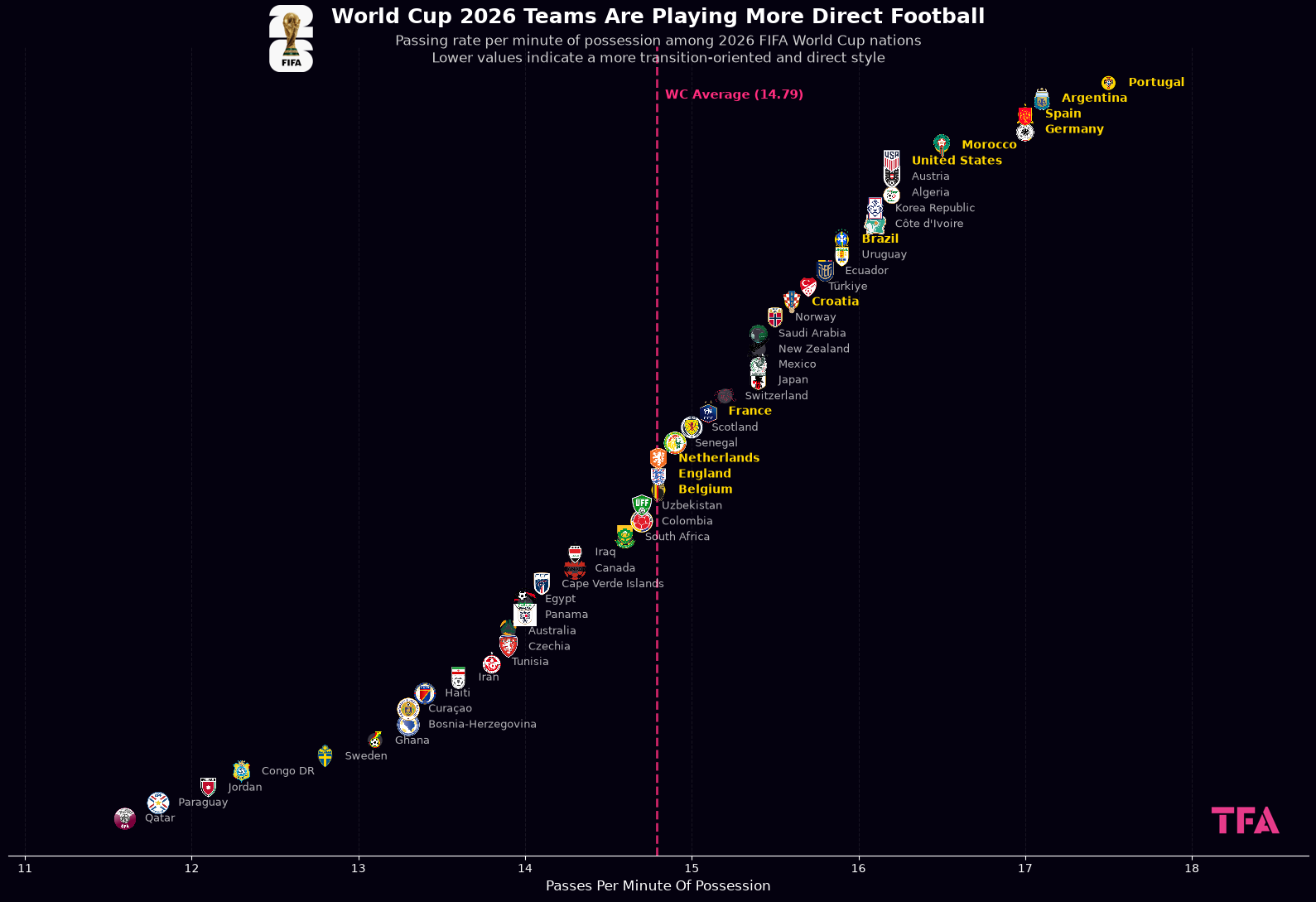
The core question is whether Norway’s defensive shape can survive long spells without the ball. Brazil’s best sequences usually come from territorial suffocation: sustained circulation, wide overloads, and repeated entries that force opponents to defend their box for extended phases. That matters here because Norway are most dangerous when they can stay compact, clear the first wave, and launch direct counters into open grass. In a match like Brazil vs Norway, the team that controls territory also tends to control shot quality.
That distinction is important for a prediction-led preview. Brazil’s possession pressure generally produces a higher share of shots from the central area or after the defence has been displaced. Norway, by contrast, have to make a lower volume of possessions count. Their attack is less about volume and more about sequence value: one break, one carry, one finish. If Norway are forced into repeated long defensive phases, their margin for error shrinks sharply.
Brazil vs Norway: Shot Quality
Brazil’s 2-1 win over Japan is a useful reference point because it showed how a match can swing once their chance creation starts landing in better zones. Brazil do not need a flood of chances; they need enough high-quality looks to make their territorial advantage measurable. Norway’s challenge is to prevent that from becoming a steady xG climb rather than a scattered shot chart.
From a model perspective, this is where the preview becomes blunt: if Brazil keep Norway pinned and recycle attacks after clearances, their expected goals should rise through volume and location. If Norway can keep the game narrow and force Brazil outside the prime central lanes, the profile changes. The difference between a controlled Brazilian win and a narrow, low-event game is often whether the first 30 minutes produce clean box entries or only blocked half-chances.
Haaland and the Counter
Norway’s route is obvious but still dangerous. Haaland gives them a direct out-ball that changes the geometry of every turnover. When Norway break cleanly, the final action can be immediate, and that makes Brazil’s transition defence critical. If the fullbacks push high and the midfield rest-defence is slow to reset, Norway only need a handful of exits to create real threat.
The research context also points to Norway’s resilience in a modern knockout environment: their 2-1 win over Ivory Coast was framed around surviving pressure and converting efficiently. That is the blueprint here. Norway do not need to dominate possession; they need to survive the long phases, win the second ball, and make Brazil pay for any structural overcommitment.
For ScorePoint AI’s lens, the key is not simply who attacks more, but which side can turn transitions into the better shot profile. Brazil may generate the larger total, but Norway’s best chances could be cleaner if they arrive before the defence is set.
Set Pieces and First Goal
Set pieces may be the quiet edge in Brazil vs Norway. In a match where Norway are likely to spend long stretches defending, dead-ball moments become a major lever. One corner or wide free-kick can reset the whole script, especially if Brazil dominate territory but initially struggle to convert pressure into open-play separation.
First goal importance is high. If Brazil score first, Norway have to open their shape earlier than they want, which increases the space behind the midfield line and raises Brazil’s chance volume. If Norway strike first, the game flips: Brazil must attack a deeper block, and Norway’s counter efficiency becomes even more valuable. That single event may tell the model more than possession share alone.
- Brazil edge: sustained possession and better chance volume from territorial pressure.
- Norway edge: direct counterattacks led by Haaland and efficient use of fewer possessions.
- Set-piece watch: a likely source of low-frequency, high-value chances.
Outlook
This Brazil vs Norway preview points to a game defined by control versus escape. Brazil should have the ball for long stretches, but possession alone will not settle it unless they turn territory into box entries and cleaner shot quality. Norway’s survival case depends on compact spacing, sharp transition defence, and enough counter threat to keep Brazil honest. The first goal may be decisive, because it determines whether this becomes a territorial squeeze or a more open transition match.
On the balance of the data available, Brazil carry the more stable chance-creation profile, while Norway’s upset route rests on efficiency rather than volume. That makes the model’s focus straightforward: territory, transition defence, and dead-ball value, not just headline names.
Research references
These sources were checked while preparing this ScorePoint AI analysis.