World Cup Transitions Could Decide Tomorrow’s Fixtures
A data-led World Cup analysis of why turnovers, counters and set pieces may matter more than possession in tomorrow’s knockout fixtures.
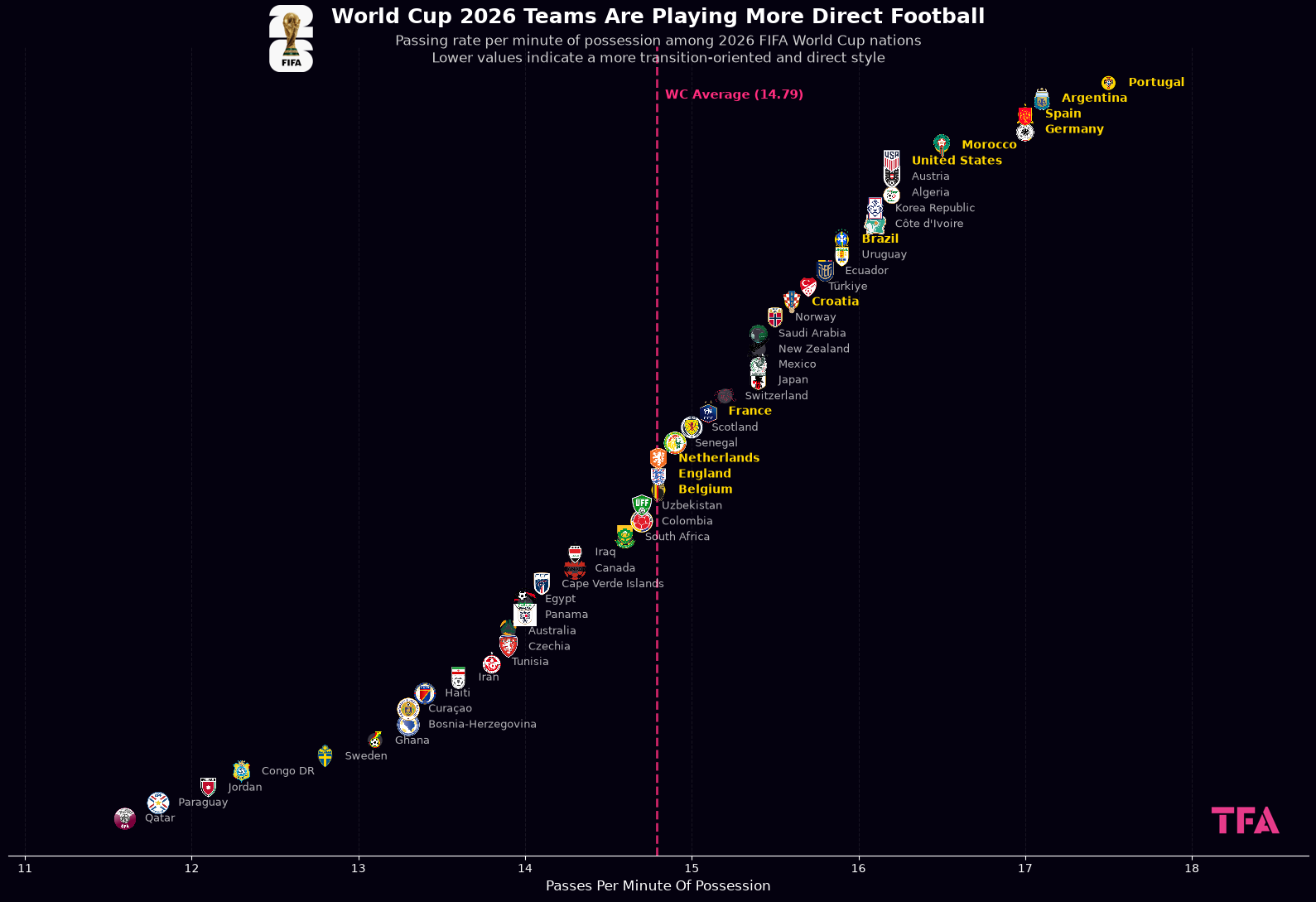
Tomorrow’s World Cup fixtures point to a familiar knockout truth: possession is not the same as control. The most revealing numbers in the pre-match data are not pass counts or territory shares, but the moments teams win the ball, how quickly they attack after it, and whether they can turn a half-chance into a clean shot. That is especially clear in Switzerland vs. Algeria, where both sides arrive with enough attacking quality to punish sloppy rest defense, and in the wider knockout slate where transition teams have already forced variance.
Transition zones matter most
The model used at ScorePoint AI puts extra weight on turnover zones because they tell us where possession becomes danger. Switzerland’s profile is built on volume: 2.3 goals per game, 2.1 expected goals per game, 15.3 shots per game and 69% average possession. Algeria’s public tournament sample is less complete in the boxscore, but the results show a different shape: a 3-3 draw with Austria, a 2-1 win over Jordan, and a 1-0 win at the Netherlands. That mix suggests Algeria can live without the ball and still punish space when the game opens up.
For Switzerland, the key risk is that high possession can create exposure if the first press is broken. They have scored 11.0 chances created per game, but they have also conceded 1.0 goals against per game. Against a transition opponent with a player like Riyad Mahrez, that margin is thin.
Switzerland vs Algeria preview
This Switzerland vs Algeria preview is less about long spells of sterile control and more about which side handles the first five seconds after a turnover. Switzerland come in off a 2-1 win over Canada, plus earlier 4-1 wins over Bosnia and Herzegovina and Jordan. They have the cleaner statistical base, but Algeria’s recent run includes a lively 3-3 against Austria and a 2-1 victory over Jordan, which is exactly the kind of form that can scramble a knockout match.
Player data makes the contrast sharper. Switzerland’s attacking load has been spread around, with Johan Manzambi on 3 goals, Breel Embolo on 2 goals and 2 assists, and Manuel Akanji leading the player ratings at 7.1. Algeria, by contrast, lean heavily on Mahrez, who has 2 goals, a 7.0 rating and 1 player of the match award in the data provided. That kind of concentration often increases transition value: if Mahrez gets the ball facing forward after a turnover, Algeria can skip buildup entirely.
Counterattack efficiency
Recent knockout games have reinforced the same pattern. In the listed World Cup results, Ecuador beat Germany 2-1, Tunisia were beaten 3-1 by the Netherlands, and Türkiye beat the United States 3-2. Those scorelines are a reminder that the side with less ball can still win if its counters are cleaner and its defensive rest shape is better. That is exactly why this analysis centers on transition efficiency rather than possession totals.
Switzerland’s numbers suggest they can sustain pressure, but Algeria’s recent 3-3 game shows they are comfortable in open territory. When a match moves from controlled buildup to broken-field football, the final pass matters more than the first 20 touches. This is where underdogs can force variance: a single recovery near midfield, a direct carry, and one accurate delivery can swing the whole game.
Set pieces and variance
If transition chances are the first layer, set pieces are the second. Knockout fixtures often flatten into marginal edges, and that is when dead-ball delivery and aerial targets decide the rest. Switzerland’s profile does not rely on one scorer alone, but Algeria’s dependence on Mahrez raises the value of wide free kicks, corners and second balls. In matches where open-play possession is contested, the side that can create volume from set pieces often steals the higher-quality chances.
The broader tournament context matters too. France have advanced with a 4-1 win over Norway after their earlier group work, while Japan and Sweden drew 1-1 in a game that stayed tight because neither side consistently converted transitions. Elsewhere, Spain beat Uruguay 1-0, showing how a single moment can beat territory. That is the template tomorrow’s fixtures could follow: not dominance by possession, but dominance by the decisive action after the ball changes hands.
Practical outlook
The cleanest read for tomorrow is simple. In Switzerland vs Algeria, the side that protects turnover zones and turns the first counter into a shot will likely control the result more than the side that posts the higher possession number. Switzerland arrive with the steadier statistical base; Algeria arrive with the more volatile counterpunch. That is exactly the kind of matchup where a knockout preview should look past circulation and toward transition quality, set-piece dependency and the ability of an underdog to bend variance in its favor.
Research references
These sources were checked while preparing this ScorePoint AI analysis.