Carabao Cup Tuesday: Rotation-Adjusted Match Analysis
A data-led Carabao Cup Tuesday preview weighing rotation, depth, rest, home advantage and game state across five third-round fixtures.
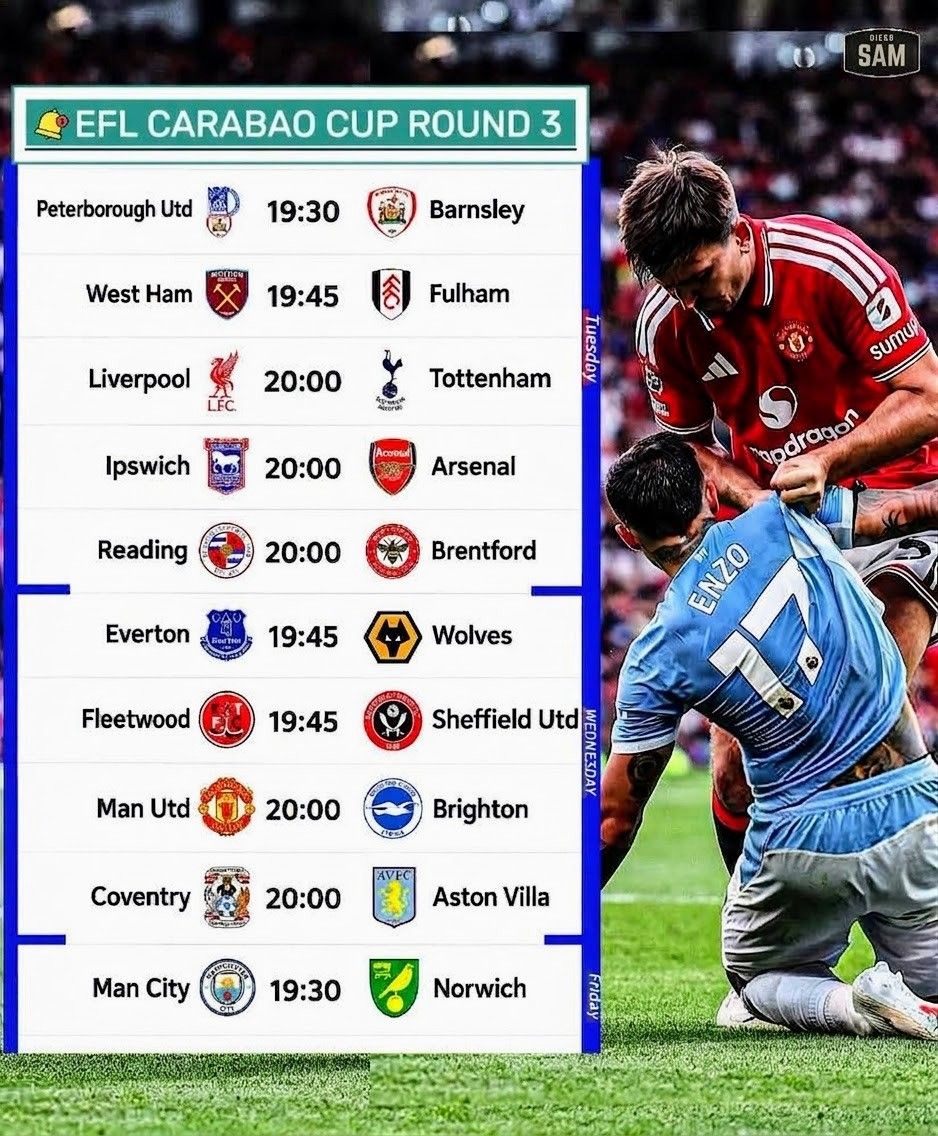
Tuesday’s Carabao Cup schedule contains five third-round fixtures: Peterborough United v Barnsley, West Ham United v Fulham, Reading v Brentford, Ipswich Town v Arsenal and Liverpool v Tottenham Hotspur. All are listed for 7.45pm, with Arsenal and Tottenham’s matches scheduled for 8pm. The central prediction problem is not simply identifying the biggest club. It is measuring how much each team’s expected starting XI changes the underlying strength gap.
Public pre-match information is limited before confirmed lineups, so this analysis treats the slate as a rotation exercise rather than a set of fixed conclusions. The strongest signal should come from the difference between each club’s first-choice level and its credible second unit, adjusted for home advantage, rest and likely game state. That is the lens ScorePoint AI should apply before turning any early favourite status into a firm prediction.
Carabao Cup Rotation Framework
Rotation matters most when a team’s attacking structure depends on a small number of high-impact starters. A weakened XI can still control possession, but it may lose pressing coordination, final-third creation and the ability to recover after turnovers. Conversely, a deep squad can rotate without losing its defensive distances or transition threat.
The model should therefore separate nominal squad strength from lineup-adjusted strength. A Premier League side fielding six or seven regulars may remain structurally safe against a lower-division opponent. A side resting its goalkeeper, centre-back pairing and main ball-progressor at the same time carries a different risk, particularly away from home.
- Expected lineup: count likely regular starters, not just the club’s reputation.
- Depth: assess whether replacements have played together and whether they preserve the team’s usual pressing and build-up patterns.
- Rest: account for the physical cost of the previous fixture and the next scheduled priority.
- Venue: give home teams credit for familiar surroundings and lower travel burden.
- Game state: model whether an early goal could force an open match or allow the stronger side to manage a lead.
Five Tuesday Matchups
Peterborough United v Barnsley
This is the slate’s clearest depth-neutral matchup: both teams enter without the obvious Premier League talent gap present elsewhere. That makes lineup news especially important. With no detailed injury, form or player-usage data supplied in the public preview, the model should avoid manufacturing a strong edge. Home advantage is the main confirmed structural factor, while the absence of European scheduling pressure means rotation should be assessed through recent league workload rather than assumed.
West Ham United v Fulham
The London derby is a useful warning against ranking teams by division alone. West Ham have the higher top-end profile, but Fulham’s proximity reduces travel friction and the home side cannot assume a slow, low-intensity cup match. The key variable is whether West Ham retain enough first-choice defensive organisation to handle Fulham’s transitions. Without confirmed lineups or public player-level form in the supplied data, this preview supports a cautious, lineup-dependent assessment rather than a reputation-based selection.
Reading v Brentford
Reading receive home advantage against a Brentford side from the Premier League, but the matchup is precisely where rotation can distort the apparent gap. Brentford’s edge depends on how many senior defenders and attacking connectors remain in the XI; Reading’s opportunity grows if the visitors lose their normal pressing relationships. The available research gives no verified player availability or recent score sequence for either club, so the best model output should wait for team news and treat any early strength estimate as provisional.
Ipswich Town v Arsenal
Ipswich face Arsenal at home, with the visitors listed for an 8pm start. Arsenal’s squad depth gives them a plausible rotation advantage, but the away setting and cup format raise the value of a strong opening phase from Ipswich. The decisive question is not whether Arsenal are stronger in aggregate; it is whether their rotated midfield can prevent Ipswich from turning recoveries into direct attacks. The public fixture data confirms the tie and venue, but not lineups, recent scores or individual availability, so this is a classic “wait for XI” fixture.
Liverpool v Tottenham Hotspur
The headline tie is the most difficult to reduce to a simple favourite-versus-underdog model. Liverpool and Tottenham meet at Anfield, with an 8pm kickoff, and both clubs face the possibility that rotation changes the match from a high-level tactical contest into a depth test. Home advantage supports Liverpool, while Tottenham’s upset path improves if their first-choice attacking structure is retained and Liverpool rotate across the defensive spine. Because the supplied research contains no confirmed starters, injuries or recent head-to-head figures, the correct analysis is scenario-based rather than overconfident.
Where Value Can Appear
The best prediction spot may not be the strongest club. It may be the fixture where the market, or a basic model, overweights badge strength while ignoring a heavily altered XI. The opposite is also true: a deep Premier League squad can remain safe when its replacements fit the same tactical framework.
For this Carabao Cup analysis, the cleanest pre-lineup approach is to rank uncertainty first. Peterborough v Barnsley has the smallest obvious division-based gap; West Ham v Fulham carries derby volatility; Reading v Brentford and Ipswich v Arsenal hinge heavily on away rotation; Liverpool v Tottenham combines elite depth with the highest attacking ceiling.
Practical Tuesday Outlook
Wait for confirmed lineups before converting this preview into a final prediction. Upgrade a favourite when its goalkeeper, central defenders and primary progression players remain intact. Downgrade it when rotation removes both defensive continuity and its main source of chance creation. Give home sides extra weight in evenly matched ties, but do not confuse possession with control if the game-state model expects early transitions.
The useful conclusion is narrow: Tuesday’s Carabao Cup slate should be solved through lineup-adjusted structure, not club hierarchy. The strongest signal will come from identifying which rotations preserve a team’s usual identity—and which ones merely preserve its name.
Research references
These sources were checked while preparing this ScorePoint AI analysis.