China PR 0-5 Palestine: Friendly Recap and Model Signals
Palestine stunned China 5-0 in Chongqing. A look at the goals, China’s defensive errors and the pre-match signals that matter for future predictions.
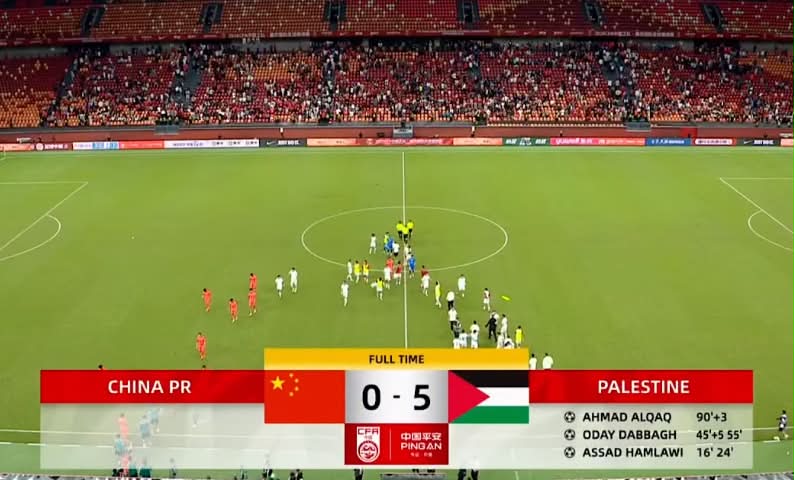
Palestine turned a friendly in Chongqing into a five-goal statement, beating China PR 5-0 on October 2 after leading 3-0 at half-time. Assad Al-Hamlawi scored twice inside the opening 22 minutes, Oday Dabbagh added a brace either side of the interval, and Ahmad Al-Qaq completed the score in stoppage time. For a model-led reading of the result, the central lesson is not simply that Palestine won: recent form and defensive risk mattered more than China’s historical edge in this matchup.
China PR 0-5 Palestine Recap
Al-Hamlawi opened the scoring in the 16th minute and struck again six minutes later. Palestine’s early double punished a China side that struggled to protect space, particularly around fullback Liu Yang, whose repeated errors were identified as a factor in the first-half collapse. Dabbagh made it 3-0 at 45+5, giving the visitors a commanding lead before the break.
China coach Xia Jiayu set his side up in a 4-4-2 against Palestine’s 4-3-2-1. The formation was not enough to contain the visitors’ forward threat, while China also missed a one-on-one chance through Tao Changlong. Dabbagh scored again in the 54th minute, and Al-Qaq added the fifth at 90+3. China made eight second-half substitutions, but the changes did not prevent further damage.
The final numbers underline the difference in execution: China had 12 total shots and three on target; Palestine recorded 15 shots and nine on target. Saves were level at three apiece, and each side received one yellow card. China also hit the woodwork twice, but those near misses could not offset Palestine’s much higher rate of shots on target.
Pre-Match Signals and Risk
The recent-results picture offered warnings for both sides. China had beaten Maldives 3-0 but then lost 3-0 to New Zealand on September 27. Palestine arrived after a 2-2 draw with New Zealand and a 4-2 win over Tajikistan. Those results pointed to a contrast: China had shown a clean-sheet ceiling against weaker opposition, but its latest defeat raised questions about defensive reliability; Palestine had demonstrated both attacking output and the ability to compete in a more open game.
Historical head-to-head data favored China, which had been unbeaten in six recorded meetings, with four wins and two draws, including a 2-0 victory in 2023. The pre-match rankings were close—China 91st and Palestine 95th—so neither ranking gap nor the old matchup record captured the risk visible in the teams’ recent performances. No specific pre-match model probability is available here; the useful analysis is the signal mix, not a claim that a model forecast this exact score.
For a prediction model, the practical inputs are the sharp recent-form split, Palestine’s transition threat and China’s exposure when its defensive shape breaks. The 9-3 advantage in shots on target is stronger evidence of a sustained performance gap than the five-goal margin alone. China’s missed one-on-one and two efforts off the woodwork also show why shot totals and finishing outcomes should be read separately.
What the Result Changes
The scale of the defeat is striking against the previous head-to-head record, but a friendly carries lineup and substitution uncertainty. China’s eight second-half changes make the final score a less clean measure of its starting XI than the first-half 3-0 deficit. Still, the match exposed concrete issues: Liu Yang’s space coverage, Tao Changlong’s missed opportunity and, after the break, critical mistakes from substitute goalkeeper Yan Juling that contributed to further goals.
Palestine, meanwhile, converted its attacking pressure into a decisive result. Al-Hamlawi’s early brace created the game state; Dabbagh’s goals widened it; Al-Qaq’s late strike finished it. Readers comparing this performance with Palestine’s earlier 4-2 win over Tajikistan can find a related Palestine friendly recap.
What to Watch Next
For China, the next useful signal is whether the defensive spacing and goalkeeper errors recur, especially when opponents attack quickly. A stronger response would mean fewer clean looks on target, not merely more possession. For Palestine, the test is whether the finishing and transition threat carry into the next fixture against a side that denies space more effectively. Any future prediction should weigh confirmed lineups and the opponent’s defensive profile alongside this result. That is the practical takeaway from this China PR 0-5 Palestine recap: use the five goals as evidence, but separate repeatable chance creation from friendly-specific game-state effects.
Research references
These sources were checked while preparing this ScorePoint AI analysis.