How AI Models Predict Champions League Knockout Ties
How a prediction model handles two-legged Champions League ties, aggregate scores and penalty shootouts, using Arsenal's Porto tie as a worked method example.
Knockout ties are where a Champions League model earns or loses its credibility. Two legs, one aggregate, and a shootout that can decide everything. This analysis explains how a prediction model should handle that structure, and where the public data limits what we can say about a specific tie.
How the Knockout Format Changes the Model
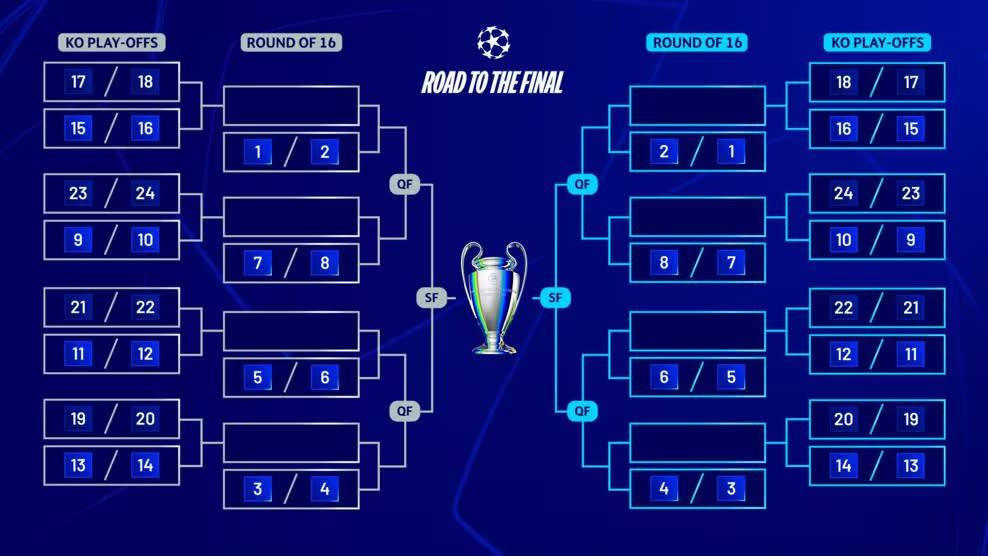
The 2026/27 calendar has three knockout stages after the league phase. Play-offs are played in February 2027 between the 9th- to 24th-placed clubs. The round of 16 follows in March, and the quarter-finals and semi-finals run through April and May. Every stage after the play-offs is two legs, and the bracket is fixed from league-phase seeding, so the draw no longer reshuffles each round.
That fixed bracket makes seeding a modeling input, not just a headline. League-phase standings now matter down to a single goal. Finishing 8th instead of 9th means a bye instead of two extra high-intensity matches in February.
Step One: Normalize Clubs Across Leagues
Before any tie is simulated, clubs from different domestic leagues have to sit on one scale. A raw form comparison misleads, because a 70% domestic win rate in one league is not the same as 70% in another. Public modeling notes describe re-weighting expected goals, expected goals against and shot quality by the strength of the competition each club played in.
Mid-way through the league phase, the Opta supercomputer projected Real Madrid at 19.50 expected points, Paris Saint-Germain at 19.48, and Arsenal third at 18.84. Bayern Munich (16.73), Barcelona (16.53), Manchester City (16.42) and Liverpool (15.86) completed the projected top seven. Those are league-phase projections, not knockout probabilities, but they show how close the seeding race was.
Step Two: Simulate Two Legs as One Tie
A two-legged tie is not two independent matches. The model should treat the first leg as state that changes how the second leg is played. Teams protecting a lead tend to reduce risk, and teams chasing a deficit tend to push numbers forward. A sound approach works through the tie in sequence:
- Leg one: simulate the scoreline distribution from adjusted expected goals, with home advantage applied.
- Aggregate update: carry the result forward and recalculate the aggregate margin for each simulated path.
- Leg two: condition attacking intensity and expected goals on the aggregate state, not on the club's season average.
- Extra time and shootout: route any drawn aggregate into extra time, then into a penalty shootout, with separate probabilities for each stage.
Run across many simulations, this produces a distribution of advancement probabilities rather than a single predicted winner.
Penalty Shootout Probability: Arsenal and Porto
Arsenal's penalty win over Porto is the scenario readers asked about, but the public pre-match and match data available for this analysis is limited. We will not reconstruct that tie's scorelines or pre-tie probabilities. What we can show is how the model prices the shootout route once a tie reaches it.
Illustrative example, using hypothetical figures rather than the actual Arsenal-Porto numbers: suppose a tie is level on aggregate after extra time. The model would first assign the shootout a probability close to a coin flip, then move away from 50% only where there is reliable evidence, such as a clear advantage in goalkeeper save data or a stronger record in recent shootouts. Small samples are discounted heavily, because a handful of penalties says little about a whole squad.
The decisive question is whether a shootout is truly a coin flip or whether it carries a measurable edge. Most of the variance comes from the two legs before it.
What the Model Should Care About
- Seeding position: a single league-phase place can change the number of high-intensity matches a club plays.
- Aggregate state: a one-goal lead changes the second leg more than a single shot-quality rating.
- Cross-league strength: normalized numbers matter more in knockouts, because the opponents are unfamiliar to each other.
- Shootout probability: treat it as a low-confidence outcome unless the evidence is strong.
Practical Outlook for the 2027 Knockouts
The next checkpoint is the February play-off draw. Clubs finishing 9th to 24th will face two-legged ties, and the seeding determines who meets whom. For the round of 16 and beyond, the fixed bracket means every club's path is visible in advance, which makes the analysis of seeding and aggregate state more useful than predicting a single scoreline.
For readers, the most useful lens is probability rather than certainty. A tie that looks one-sided on paper can still turn on one leg, and the shootout remains the least predictable part of the knockout structure.
Research references
These sources were checked while preparing this ScorePoint AI analysis.