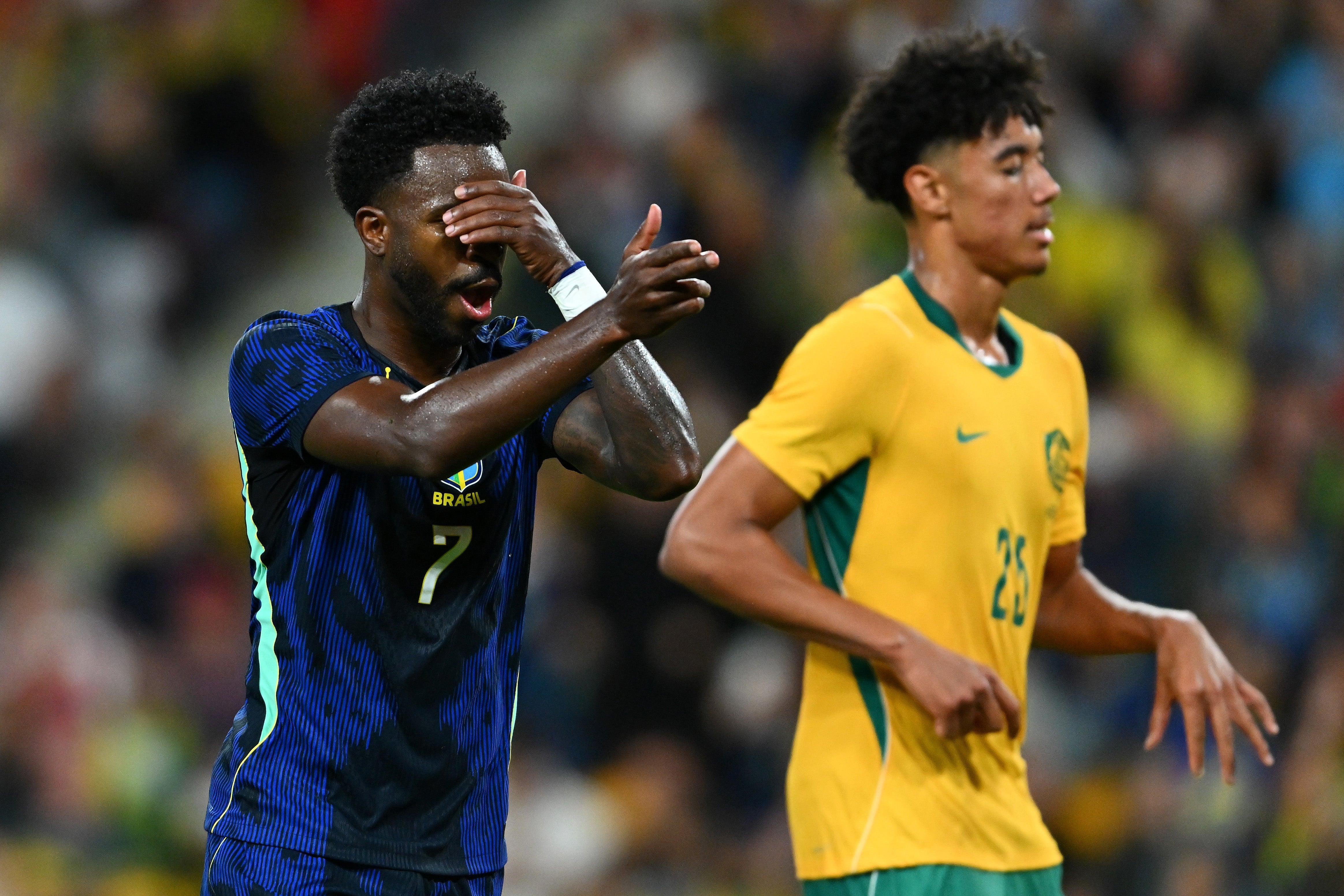
Australia 2-4 Brazil: Friendly Recap and Model Signals
Australia led Brazil before falling 4-2 in Brisbane. See how the comeback, two penalties and pre-match signals shape the next prediction read.
Australia turned a difficult test into a 2-1 lead, but Brazil’s quality and second-half response decided a 4-2 friendly in Brisbane. Connor Metcalfe scored a long-range goal as the Socceroos threatened an upset; Raphinha, Bruno Guimarães and Vinícius Júnior then helped Carlo Ancelotti’s side complete the comeback. For prediction readers, the result is a useful reminder that a strong home start and a favorable early score do not erase the gap in individual attacking options.
Australia 2-4 Brazil: Match recap
Brazil opened the scoring through Vanderson, but Australia recovered and moved in front at 2-1. Metcalfe, the St. Pauli midfielder, struck from outside the box for his third Australia goal. His finish continued a productive international run: he had also scored Australia’s first goal of the World Cup in the 2-0 win over Türkiye.
Brazil restored parity from the penalty spot through Raphinha. Bruno Guimarães put the visitors ahead, and Vinícius Júnior converted another penalty to make it 4-2. The sequence shows how quickly the match shifted after Australia had established its lead: Brazil scored three times without reply to turn a competitive position into a two-goal win.
The result followed a 1-1 draw between the sides in Townsville the previous Friday. Australia again demonstrated that it could trouble Brazil, but the second meeting produced a sharper response from Ancelotti’s team. Raphinha and Vinícius, who had faced criticism after their performances in the first fixture, both scored in Brisbane.
What the pre-match signals suggested
The available pre-match context supported two competing reads rather than a simple Brazil certainty. Brazil’s depth and the presence of players such as Raphinha, Vinícius and Guimarães pointed to a higher ceiling in decisive moments. Australia’s home setting and the preceding 1-1 draw, however, argued against treating the matchup as one-sided. The Socceroos’ two goals in Brisbane reinforced that attacking threat.
No verified pre-match probability percentages or detailed model output are available in the match information, so it would be misleading to claim that a specific forecast was confirmed. The useful model lesson is about separating result probability from match-state risk: Australia’s 2-1 advantage showed that Brazil could be put under pressure, while the final score underlined the danger of assuming that a lead would hold against Brazil’s individual quality.
Tactical risk and player impact
Metcalfe’s strike was a clear Australian route to goal: a midfielder arriving with the confidence to shoot from range. For Brazil, the comeback was spread across three different contributors. Raphinha’s penalty brought the teams level, Guimarães supplied the go-ahead goal, and Vinícius added the final score from the spot. That variety matters to predictive analysis; Brazil did not rely on one scorer to rescue the result.
Penalties played a notable part in the final margin, with Raphinha and Vinícius both converting. A model assessing future matches should treat penalty events as important but relatively high-variance moments, not as proof that the same scoring pattern will automatically repeat. Australia’s two goals and Brazil’s four also make a goals-focused reading plausible for this pairing, while the 1-1 first friendly is a reminder that their meetings can take different shapes.
Australia’s lineup included Köln midfielder Paul Okon-Engstler, who started both friendlies. Metcalfe’s scoring contribution gives the midfield another concrete attacking signal to track. Brazil’s response, meanwhile, offers evidence of a squad capable of changing the game after falling behind, rather than simply controlling it from the outset.
What to watch next
Brazil’s next listed fixture is against India in Kolkata, described as the country’s first-ever meeting with the South American side. That will present a different opponent and setting, so the Australia result should inform—not dictate—the next forecast. Readers can follow the earlier Australia 1-1 Brazil recap and model signals for the first meeting’s context.
For Australia’s next prediction read, the practical questions are whether Metcalfe can sustain his goal threat, whether the side can protect an advantage against elite opposition, and how much weight to give the two Brisbane penalties. For Brazil, the key signal is the ability of Raphinha, Guimarães and Vinícius to turn a deficit into a win. This 4-2 recap points to Brazil’s greater finishing depth, but Australia’s two goals—and the earlier draw—counsel against reading the scoreline as a complete measure of the gap.
Research references
These sources were checked while preparing this ScorePoint AI analysis.