Russia 2-0 Iran: Friendly International Recap and Analysis
Alexander Golovin scored twice as Russia beat Iran 2-0 in Kazan. See what the result says about form, model signals and Russia’s next tests.
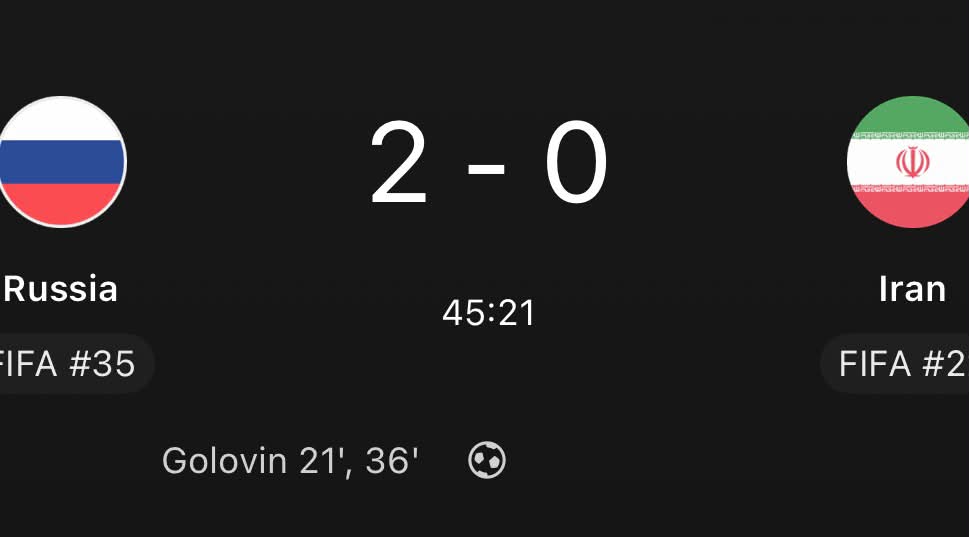
Russia beat Iran 2-0 in their friendly in Kazan, with captain Alexander Golovin scoring in the 21st minute and converting a penalty 15 minutes later. The result extended Russia’s run of consecutive wins without conceding to three, following 3-0 victories over Trinidad and Tobago and Burkina Faso. More than 34,000 spectators attended.
Russia 2-0 Iran Recap
Golovin, the Monaco midfielder, supplied both goals in a decisive first-half spell. His opener put Russia ahead in the 21st minute; the second arrived from the penalty spot in the 36th. Russia therefore took a two-goal cushion into the break, and the final score remained unchanged.
The penalty mattered beyond the scoreline: it gave Russia a second route to a goal after Golovin’s opener from open play. But the available match information does not include shot totals, possession figures or a detailed account of the build-up to the spot kick. It would be a stretch to treat the score alone as proof of territorial dominance or a particular attacking pattern.
For Iran, the 2-0 defeat means the side left Kazan without a goal, while Russia recorded another clean sheet. The public match data offers few verified details about Iran’s lineup or chances, so the clearest comparison is the outcome: Russia converted twice before half-time, and Iran did not get onto the scoresheet.
What The Model Signals
There is a clear form signal for any pre-match model assessing Russia: three straight wins, three clean sheets and eight goals scored across the sequence. The latest 2-0 against Iran followed 3-0 results against Trinidad and Tobago and Burkina Faso. That run supports a positive reading of Russia’s recent results, but it should not be mistaken for a complete measure of attacking or defensive performance without chance-quality data.
ScorePoint AI readers can also separate repeatable evidence from a single-match event. Golovin’s brace is a strong individual contribution, but one penalty and one open-play goal do not establish that Russia will keep scoring at the same rate. A careful model update would weigh the win and clean sheet alongside opponent strength, available lineup information and whether Russia continues to create chances in its next fixtures. Those details are not established by the reported scoreline.
The pre-match public data available here is limited: it does not provide comparable recent-form figures for Iran, expected lineups, or underlying chance numbers for either side. That limits how confidently the result can be used to revise a forecast. Russia’s three-match sequence is concrete; the gap between the teams’ broader performance levels is not quantified by this information.
Golovin, Risk And Game State
Scoring twice inside the opening 36 minutes shaped the risk calculation for both teams. Russia could protect a two-goal advantage rather than chase a more open game, while Iran had to seek a way back into the contest. That is a game-state inference, not evidence of a documented tactical switch: no verified possession or substitution breakdown is available in the match details.
Golovin is the obvious player-level signal. His opener and penalty made the difference on the scoreboard, but future predictions should distinguish a player’s involvement from a reliable trend in team chance creation. For Iran, the practical question is whether the attack can produce a response in its next match; this recap does not supply enough detail to identify a specific weakness or single player responsible.
Readers looking at the pre-match framing can compare it with this result in the Russia vs Iran friendly preview. The useful exercise is not to treat a correct score direction as proof that every underlying assumption was right, but to check which signals—recent results, lineup choices or goal production—actually appeared in the match.
What To Watch Next
Russia’s next listed tests are Namibia and Nigeria. Those fixtures offer a chance to see whether the three-game run of clean sheets and eight goals carries forward against different opposition. For prediction models and free-pick readers, the useful checkpoints are whether Golovin remains central to the scoring, whether Russia keeps its defensive record, and whether the next results are supported by repeatable chance creation rather than isolated finishing moments.
Iran’s 2-0 loss is a result to account for, not a complete verdict on the team. With limited public detail on its chances and recent form in this match context, the next forecast should avoid overreacting to the score alone. The practical outlook is measured: Russia has a strong recent results signal, while further match data is needed to make a similarly specific claim about Iran.
Research references
These sources were checked while preparing this ScorePoint AI analysis.