International Friendly Predictions: Check Lineups and Risk
A practical framework for reading friendly predictions: separate team strength from lineup news, assess motivation uncertainty and apply it to Argentina vs Bolivia.
International-friendly predictions need a lineup and uncertainty check before they are treated as a firm read. Tomorrow’s slate is made up of friendlies, where a team’s established strength can still matter, but rotation, unfamiliar combinations and shifting priorities may change the match picture. The useful question is not simply which side is stronger; it is how much the available lineup could alter that baseline.
Separate Strength From Lineups
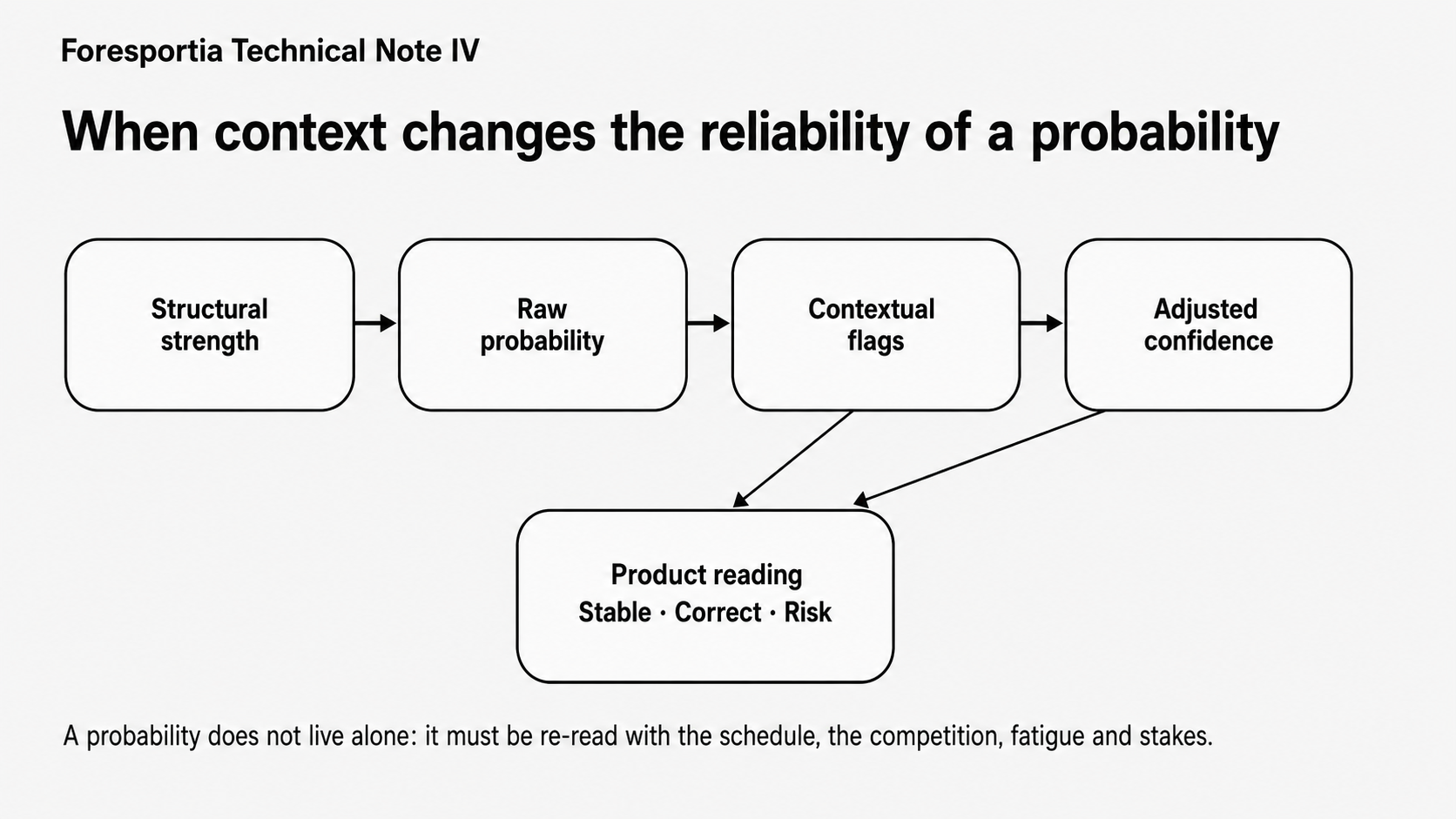
Start with a baseline built from evidence that is not dependent on one predicted starting XI: overall team quality, recent competitive performance and the depth of the player pool. Keep that assessment separate from late news. If the two are blended too early, a strong team can appear certain to win even when its likely lineup is substantially weaker than its usual first choice.
Then make a distinct lineup adjustment. Ask whether likely absences affect a role that is difficult to replace, such as the main chance creator, a centre-back pairing or the goalkeeper. The number of changes matters, but so does their position: four rotations across a settled midfield may be less disruptive than one change that breaks up the central defensive partnership.
This is a framework for evaluating a prediction, not a claim about hidden model inputs. A published probability does not reveal whether it has fully accounted for an expected XI, a late withdrawal or a planned substitution pattern. Treat the baseline and team-news adjustment as separate questions rather than assuming the displayed forecast has resolved both.
Argentina vs Bolivia: Context Matters
Argentina vs Bolivia is a useful example of why past results need context. Argentina beat Bolivia 6-0 in a 2024 World Cup qualifier, with Lionel Messi scoring a hat-trick. That is a concrete marker of the gap Argentina can create in a competitive setting; it is not evidence that a friendly will reproduce the same score or conditions.
The competition setting is part of the signal. A qualifier carries points and standings consequences; a friendly may be used to assess combinations or distribute minutes. The public pre-match information available for this analysis does not establish the teams’ confirmed lineups, likely rotation, or specific motivation plans for this fixture. It would therefore be misleading to claim Messi will start, to assign a particular XI to Bolivia, or to turn that 6-0 result into a current forecast.
For an Argentina vs Bolivia prediction, keep the historical strength signal in the baseline, then leave room for a wider range of outcomes until team news clarifies who is available and how the match may be approached. The same caution applies to Bolivia: without reliable lineup detail, do not invent a tactical change or assume its personnel are unchanged.
Measure Friendly Uncertainty
A practical review can use three checks. First, compare the expected XI with the strongest plausible XI and identify where quality or familiarity changes. Second, separate confirmed information from speculation: a named absence is different from a predicted rotation. Third, ask whether the forecast remains persuasive under more than one reasonable lineup scenario.
- Low lineup uncertainty: most key roles appear settled, so the baseline can carry more weight.
- Medium uncertainty: several starters may rotate, but the replacements and team structure are reasonably clear.
- High uncertainty: major roles or the expected approach are unknown; confidence should be reduced rather than disguised as precision.
This is not a formula for manufacturing a new probability. It is a way to see what would have to be true for a prediction to hold. A forecast that depends on one uncertain starter deserves more scrutiny than one supported across several plausible combinations. The Mexico vs Peru preview on lineup risk uses the same useful distinction between team-level form and availability signals.
Practical Outlook for Tomorrow
For each friendly, write down the baseline view before checking late team news. Then update it only for confirmed or credible changes, noting whether each affects a high-value role. Avoid treating a familiar badge, a recent score or a single star’s presence as a complete explanation of the match.
In Argentina vs Bolivia, Argentina’s 6-0 qualifying win is relevant historical evidence, while the lack of confirmed pre-match lineup detail limits how specifically that evidence can be applied. That is the point of a disciplined preview: preserve what the data supports, mark what remains unknown, and lower confidence when uncertainty is material. A prediction is more useful when its assumptions are visible than when its certainty is overstated.
Research references
These sources were checked while preparing this ScorePoint AI analysis.