PSG vs Arsenal Fallout: Tactical Lessons and Next Steps
PSG vs Arsenal Champions League final fallout analyzed: tactical lessons, key performances, and what both clubs must do next after Budapest.
The Champions League final between PSG and Arsenal in Budapest delivered exactly what this matchup promised: a collision of styles, a brutal tactical chess match, and a result that will shape both clubs’ summer plans. Arsenal struck first through Kai Havertz inside six minutes, PSG controlled the ball for long stretches, and the contest eventually turned on fine margins, with a 1-1 draw after extra time followed by a shootout victory for the French side. For Mikel Arteta, the disappointment is immediate, but so is the lesson: Arsenal’s European rise is real, yet the final against the reigning champions showed where the next level still begins.
Arsenal’s Defensive Blueprint
Arsenal’s run to the final was built on structure, control and remarkable resistance. Before kickoff in Budapest, their Champions League record stood at 11 wins, 3 draws and 0 defeats across 14 matches, with only 6 goals conceded and 9 clean sheets. That profile was no accident. Arteta’s side repeatedly used a compact 4-2-3-1, protected by Declan Rice and supported by the central pairing of William Saliba and Gabriel Magalhaes, who once again were close to faultless in the final.
The opening goal fit the broader pattern of Arsenal’s knockout football. They defended deep, stayed disciplined in their shape, and looked dangerous whenever they could spring forward quickly through Martin Odegaard, Bukayo Saka and Leandro Trossard. The early strike from Havertz confirmed that Arsenal can punish even elite opposition when they win the first duel and attack the space behind advancing full-backs.
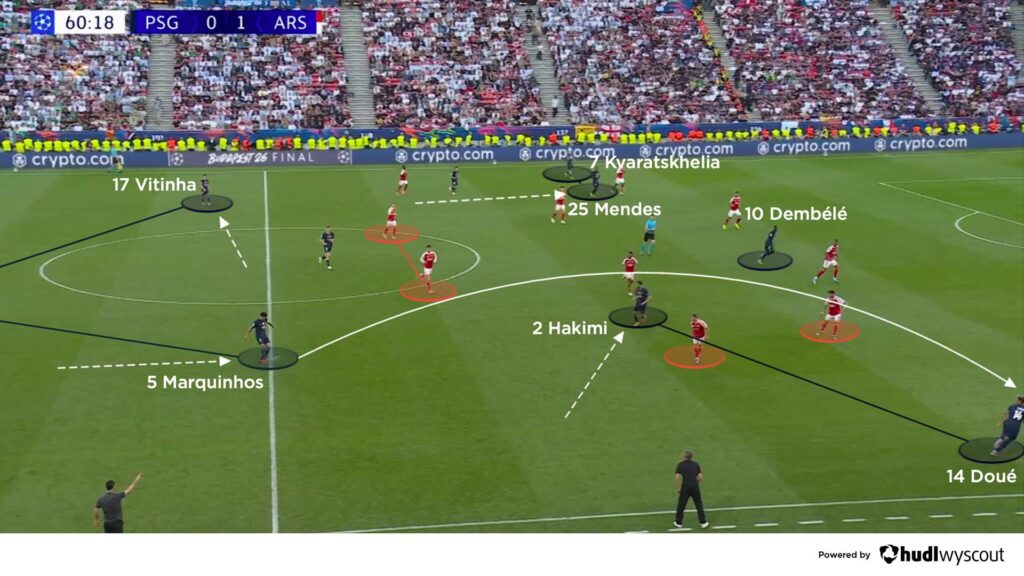
But the final also exposed the limits of a strategy built so heavily around defensive control. Once PSG settled into possession, Arsenal spent long periods in a low block and only regained rhythm when the score became level in the second half. The result was a familiar Champions League final tension: protect the box too long, and the margin for error shrinks to almost nothing.
PSG’s Possession Problem
PSG’s defining number from the final was their 72% possession, compared with Arsenal’s 28%. That imbalance tells the story of how Luis Enrique’s team dictated territory even when they did not immediately dictate the score. Their best moments came when the front line could move Arsenal’s defenders around and force the full-backs into uncomfortable zones. That pressure eventually created the equaliser, and it is the reason PSG still looked like the more likely side to score in open play after the interval.
What changed was not PSG’s willingness to attack, but Arsenal’s response after conceding. The Gunners became more ambitious, stepped higher, and opened spaces in behind that PSG’s attack thrives on. That trade-off is central to this analysis: Arsenal’s compactness frustrates opponents, but when they chase the game, they can also become more vulnerable to the very qualities that make PSG dangerous.
The final also underlined PSG’s growth as a complete European side. They are no longer only a collection of individual forwards; they are a team capable of surviving a difficult start, controlling possession against an elite opponent and then winning the game emotionally as well as tactically. Their campaign already included a wildly open 5-4 semi-final first-leg win over Bayern Munich, which showed their attacking ceiling. Against Arsenal, they proved they can also win a tighter, more measured contest.
Turning Points in Budapest
The decisive moments arrived in layers. Arsenal’s early lead forced PSG to be patient, but the French side kept the game on their terms by monopolising the ball and pinning Arsenal deep. The equaliser, coming in the 65th minute, was the breakthrough that changed the game state. From there, the match opened up: Arsenal were forced to commit more players forward, while PSG found more of the transition space they wanted.
Arteta later admitted his side needed to make “very important decisions” and that reaching another level would demand being “very ambitious, very fast and very smart.” That is a revealing post-match diagnosis. Arsenal did not collapse; they were edged out in the margins after absorbing waves of pressure, and they were still in the contest deep into extra time. But the final also showed that the difference between being a finalist and being a champion is often the ability to control one or two moments that cannot be rehearsed.
There was also frustration over a possible penalty in extra time when Noni Madueke went down under pressure, though Arteta refused to lean on that as an excuse. And then came the shootout, where Gabriel Magalhaes was among those involved in the decisive heartbreak. For Arsenal, that sequence will haunt the summer, even if the larger picture is one of progress.
What Arsenal Must Fix
Arsenal’s season can still be framed as a breakthrough: they had just won their first English league title in 22 years, and their Champions League run confirmed they are among Europe’s most organised teams. Yet the final showed three specific areas that need attention if they are to convert domestic dominance into continental success.
- Game-state management: Arsenal were strongest when leading, but struggled to regain attacking control after PSG levelled.
- Full-back depth: Injuries and uncertainty around Ben White and Jurrien Timber left their wide defensive cover stretched.
- Chance creation under pressure: When PSG compressed the pitch, Arsenal needed cleaner outlets beyond Saka and Odegaard.
The team news context mattered too. White was sidelined with a knee injury, while Timber had been a doubt after a long absence. That reduced flexibility in a match where Arteta needed reliable wide defenders against PSG’s fluid front three. Even with Gabriel and Saliba standing firm centrally, the final suggested Arsenal still need more control outside the middle of the pitch.
This is where the broader preview-to-recap arc matters. The pre-match expectation was always that Arsenal’s defensive record would keep them competitive; the post-match reality is that they now need more solutions when their first structure is beaten. Their European profile has changed, but the final made clear that the evolution is not finished.
What Comes Next
For PSG, back-to-back Champions League titles would mark a huge statement of continuity. For Arsenal, the defeat is painful precisely because it sits beside so much evidence of progress. They reached the final unbeaten in Europe, they conceded only six goals before the final, and they forced the reigning champions into a shootout. That is not a team in need of a rebuild. It is a team in need of refinement.
That refinement will likely begin in the transfer market and in the details of Arteta’s next tactical cycle. The club’s hierarchy, as Arteta stressed, must make decisions quickly, smartly and boldly if Arsenal are to keep advancing. The final in Budapest did not diminish the project; it clarified it. Arsenal now know what it takes to survive a Champions League final. The next step is learning how to win one.
For deeper match modelling after nights like this, ScorePoint AI’s AI predictions can help frame the tactical and statistical picture, while the AI assistant is useful for breaking down lineups, trends and in-game adjustments. That combination of data and context is exactly what this kind of analysis demands.
Related reading on ScorePoint AI includes PSG vs Arsenal Fallout: Summer Transfer Market Impact for the squad-building angle, as well as Canada vs Republic of Ireland Preview: Lineups & Pick and Serena Williams Comeback Confirmed: What It Means for more data-led coverage across sports.


